9/12/2009

Homonym 同字異義


sentence (句子, 判決)
The former president, Chen Shui Bian was sentenced to life in prison yesterday.
This is a long sentence.

life (終身, 生命)
life is the experience of being alive.
The judges sentenced Mr Chen to life in prison.

charge, charge
I charge my students $XXX per lesson.
The Taiwan ex-president was convicted of a total of six charges.

fine, fine
I am fine, thank you.
The ex-president was fined $6 millions.

demonstrate, demonstrate
I use the power point to demonstrate the findings.
The supporters of Mr Chen demonstrated near the court.

frequent, frequent
He likes to frequent the bar.
Mr Chen frequently clashed with Chinese leaders by asserting Taiwan's independence.

9/11/2009

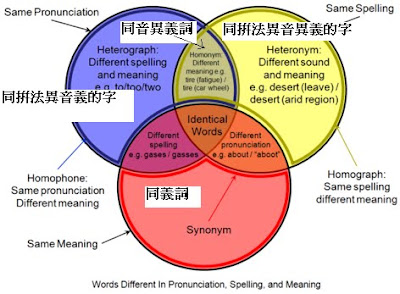
Homonym Words

Write a story with the following three pairs of homonyms.
left, left (左,離開)
row, row (一列, 划船)
bear, bear (熊,承受)

Shirley and Karen were good friends. They always sat together on the first row of their classroom. They left school and worked for a Teddy Bear House in Tsim Sha Tsiu when they were sixteen. Shirley wrote with her left hand but rowed boat with her right hand. Karen wrote and rowed with her right hand. Both of them have their own boats which could bear heavy loads.

Homonymy of English Words


homonym 同音異義詞
Homonyms are words that are pronounced or spelled the same way but have different meanings since they come from different origins. Homonymy is the state of being homonym.

Examples of homonyms are stalk (which as a noun can mean part of a plant, and, as a verb, to follow/harass a person), bear (animal) and bear (carry), left (opposite of right) and left (past tense of leave). Some sources also consider the following trio of words to be homonyms, but others designate them as "only" homophones: to, too and two (actually, to, to, too, too and two, being "for the purpose of" as in "to make it easier", the opposite of "from", also, excessively, and "two", respectively).

Extracted and adapted from Wikipedia at http://en.wikipedia.org/wiki/Homonym

19 Life Skills

I read an article from the following website that provides information and ideas for enhancing life skills adapted from the website entitled The Life Model .

Skill 1 - Share Joy
Mutual amplification of joy through nonverbal facial expressions and voice tone conveys, “We are glad to be together.” This capacity allows us to bond and grow strong brains as well.

Skill 2 - Soothe Ourself
Lowering the energy level so we can rest after both joyful and upsetting emotions, as we need to and on our own, makes us feel stable. This self-soothing capacity is the strongest predictor of good mental health for the lifetime.

Skill 3 -Form Bonds for Two
The essence of a secure bond is the ability to synchronize our attachment centers so that we can move closer or farther apart at moments that satisfy us both. Synchronized attachment centers provide the basis for smooth transfer of brain skills and learned characteristics.

Skill 4 - Create Appreciation

High levels of the emotional state of appreciation closely match the healthy balanced state of the brain and nervous system. Creating a strong feeling of appreciation in yourself or others relieves unpleasant states and stress. Appreciation is very similar to the let down reflex that produces milk flow when nursing and the warm contented feeling that follows for mother and child.

Skill 5 - Form Family Bonds
Family bonds allow us to feel joy when we have a good relationship with each other. We experience what they feel and understand how they see.

Skill 6 - Identify Heart Values From Suffering
Everyone has issues that particularly hurt or bother him/her and always have been the way he/she is likely to get hurt. Looking at these lifelong issues helps identify the core values for each person’s unique identity. We hurt more as we care more. Because of how much pain our deepest values have caused, most people see these characteristics as liabilities not treasures.

Skill 7 - Tell Synchronized Stories
When our brain is well trained, our capacity is high and we are not triggered by the past, our whole brain works together. Telling stories in a way that requires all the brain to work together is a simple test of how our brain is working as well as a method to train the brain.

Skill 8 - Identify Maturity Levels

We need to know our ideal maturity level so we know if our development is impaired. Knowing our immediate maturity level from moment to moment lets us know if we have been triggered into reactivity by something that just happened or have encountered a “hole” in our development that needs remedial attention. Watching when our maturity level is slipping also tells us when emotional capacity has been drained in us or others.

Skill 9 - Take a Breather
Sustained closeness and trust requires us to stop and rest before people become overwhelmed and when they are tired. These short pauses to quiet and recharge take only seconds. Those who read the nonverbal cues and let others rest are rewarded with trust and love.

Skill 10 - Tell Nonverbal Stories

When we want to strengthen relationships, resolve conflicts, bridge generations or cultures we get much farther with the nonverbal parts of our stories than with words.

Skill 11 - Return to Joy from the Big Six Feelings

Although we live most of our lives in joy and peace we need to learn how to stay in relationship and quiet our distress when things go wrong. When we take good care of our relationships, even when we are upset, the upset does not last long or drive people away. We quickly resolve our “not glad to be together” moments.

Skill 12 - Recall the harmonious moment

Part of maintaining our relationships when we are upset is learning to act like the same person we were when we had joy to be together. A lack of training or bad examples causes us to damage or withdraw from the relationships we value when we get angry, afraid, sad, disgusted, ashamed or hopeless.

Skill 13 - See What God Sees
Hope and direction come from seeing situations, ourselves and others they way they were meant to be instead of only seeing what went wrong. This spiritual vision guides our training and restoration. Even forgiveness flows from seeing people’s purpose as more important than their malfunctions and makes us a restorative community instead of an accusing one. Through our hearts we see the spiritual vision God sees.

Skill 14 - Stop the Sark

This Greek word (also rendered sarx) refers to seeing life according to our view of who people are and how things should be. This conviction, that I know or can determine the right thing to do or be, is the opposite of heartsight in skill 13. For the sark, people become what they have done (the sum of their mistakes) or what we want them to become for us. Blame, accusations, condemnation, gossip, resentment, legalism, self-justification and self-righteousness are signs of the sark.

Skill 15 - Quiet Interactively

Facial cues, particularly of fear, help us to know when we are pushing others too hard. Sometimes we need and want to maintain a high-energy state without “going over the top,” like knowing when to stop tickling so it stays fun. Fast recognition and response to facial cues means optimum interactions and energy.

Skill 16 - Recognize High and Low Energy Response Styles
Many characteristic responses to emotions and relationships are strongly shaped by our tendency toward high or low energy reactions. Recognizing who tends to respond with high energy (adrenalin based emotions) and who would rather withdraw helps us match minds with others and bring more helpful variety to our own response tendencies.

Skill 17 - Identify Attachment Styles

How well we synchronize our attachments (Skill 3) early in life leaves the most enduring pattern in our personality. These patterns change the way we experience reality. At one end we may give almost no importance to our feelings or relationships and at the other we may feel hurt almost constantly and think of nothing but feelings and people. We may also become afraid of the very people we need. All these factors distort our reality but feel real to us at the time. Knowing how to spot these distortions helps us compensate.

Skill 18 - Intervene Where the Brain is Stuck
By recognizing the characteristic pain at each of the brain’s five levels we can pinpoint trouble and find a solution if someone gets stuck. The type of pain gives us a good idea of the kind of solution we will need when someone is not “keeping it together,” “falling apart,” or “stuck” as we commonly call these losses of synchronization.

Skill 19 - Recover From Complex Emotions
Once we can return to joy and act like ourselves with the six big negative feelings taken one at a time, we can begin to learn how to return to joy and act like ourselves when the six are combined in various combinations. Shame and anger combine to form humiliation. Fear and hopelessness (with almost any other feeling as well) form dread. These combination feelings can be very draining and difficult to quiet.

http://www.lifemodel.org/videowmp.php?file=thriveOverview_02.wmv

8/22/2009

Tutankhamun


16 August, 2009

King Tut Exhibition

More than 3,000 years after his reign, and 30 years after the original exhibition opened in San Francisco, Tutankhamun, ancient Egypt’s celebrated “boy king,” returns to the de Young Museum. In the summer of 2009 the de Young presents Tutankhamun and the Golden Age of the Pharaohs, a glorious exhibition of over 130 outstanding works from the tomb of Tutankhamun, as well as those of his royal predecessors, his family, and court officials.

On view from June 27, 2009, through March 28, 2010 at the de Young, Tutankhamun and the Golden Age of the Pharaohs provides insight into the life of Tutankhamun and other royals of the 18th Dynasty (1555–1305 BC). All of the treasures in the exhibition are more than 3,000 years old.

Tutankhamun was one of the last kings of Egypt’s 18th Dynasty and ruled during a crucial, turmoil-filled period of Egyptian history. The boy king died under mysterious circumstances at the age of 18 or 19, in the ninth year of his reign (1322 BC). Tutankhamun’s tomb in the Valley of the Kings was filled with magnificent treasures meant to ensure his divine immortality. Many objects belonging to the young king—exquisite personal items used in his daily life—were placed in it.

Tutankhamun and the Golden Age of the Pharaohs offers glimpses of that critical period in Egyptian history. On display will be 50 of Tutankhamun’s burial objects, including one of the gold and precious stone inlaid canopic coffinettes that contained his mummified internal organs. Also included are many of the day-to-day objects enjoyed by the young king including a finely crafted child’s chair and an inlaid game board, one of four in the tomb, clearly representing an activity enjoyed by the king.

New to the encore tour of the exhibition are two nested coffinettes that contained the remains of two fetuses that are now undergoing DNA testing to reveal their relationship to King Tut. Also new to the exhibition from Tutankhamun’s tomb is a beautiful scarab bracelet featuring a central image of a beetle representing the sun god. An elaborate pectoral, a masterpiece of jewelry making, contains a rare, yellow-green glass stone carved in the shape of a scarab beetle that some scientists believe to be a fragment of an ancient meteorite.

More than 80 additional objects from tombs of 18th Dynasty royals, as well the possessions of elite individuals with close connections to the royal family also will be exhibited. These stone, faience and wooden pieces from burial sites before Tut’s reign will give visitors a sense of what the burials of both royalty and the elite may have been like and what the Egyptians of that time considered essential for the afterlife.

King Tut’s Gold Mask (or "Funerary Mask" or "Death Mask") resides at the Egyptian Museum in Cairo. The Mask is a very popular object that traveled in the 1970s exhibition and many individuals have fond memories of it. However, in the 1980s the Egyptian government declared it a national treasure and too fragile to travel. As such, it will not leave Egypt again and does not appear in Tutankhamun and the Golden Age of the Pharaohs.

Tutankhamun’s mummy, the outermost of the three coffins in which he was buried, and his quartzite sarcophagus are still located in his tomb in the Valley of the Kings in Egypt. The two additional coffins—the innermost solid-gold coffin and second coffin—are in the collection of the Egyptian Museum in Cairo. King Tut’s mummy, coffins, and sarcophagus have never traveled outside of Egypt.

Exploratorium


5 August, 2009

We visited Exploratorium on 5 August, 2009. It is a well known museum in San Francisco. It is a hands-on museum of science, art, and human perception. It has been called both the best science museum in the world and the grandfather of experimental and hands-on museums.

It is designed to spark curiosity. Visitors can touch, pick up, and tinker with hundreds of exhibits. Their curiosity will guide them to discover knowledge of the physical and biological world through the processes of discovering and validating.

There are a number of online activities on the link, http://www.exploratorium.edu/explore/online.html. Try if you are interested to know more about them.

One of the event, I enjoyed during my visit is the activities that you can access at:
http://www.exploratorium.edu/reflections/

8/20/2009

Bonfante Gardens - Gilroy Family Theme Park


3rd August, 2009 (Monday)

We visited the Gilroy Family Theme Park on 3rd August, 2009. There were a number of interesting rides for us.

Jelly Belly Factory Tour


1st August, 2009 (Saturday)

Jelly Belly Factory Tour

We visited Jelly Belly Factory on 1st August, 2009. It was located in Fairfield, California about an hour's drive north of San Francisco.

We arrived there at about 4 o'clock. Luckily we could join the last tour that lasted for about 40 minutes. During the tour, the tour guide explained to us how the jelly beans were made. It took about four to five days to make the jelly beans. All visitors got a bag of jelly bean as a free gift from the company.

I bought five bags of jelly beans. They looked and tasted really great.

8/01/2009

Terri's Vacation

Terri is on vacation to the States from 25 July to 17 August, 2009.
The photo was taken on the plane on 25 July. It's so nice to have a break spending time with my dearest family members.

7/16/2009

Fluency Training

What is fluency and how can you achieve fluency in your speech?

Fluency is the ability to communicate your thoughts and feelings and to say what you want to say without fear and hesitation. The foundation of fluency is the urge to express yourself adequately in various circumstances; such as social, academic, or work place settings.

Now, you can start working to find ways to enhance your speech ability by using the technique of reading aloud. There are steps you need to follow:
1. phrasing - words go together in groups - identifying thought/ intonation groups
2.pausing – with rhythm and phrasing – pauses should be left between thought groups
3.linking - joining sounds into words and words into phrases and sentences

Understanding the rhythm of English speech is important for learners. You will realise that any long segments of connected speech are made up of certain patterns, known as tone units. To speak effectively and comprehensively, we need to divide our speech into tone units for each thought group.
The tone unit is a part of the sentence in which there is a significant pitch pattern. Within it there will be some prominent/ stressed syllables. Stress is one the main tools in English to convey word and sentence meaning. It is important for you to control the stress system if you want to be able to speak English clearly.

7/06/2009

Introduction to the IELTS Test

Introduction to the IELTS Test

The International English Language Testing System (IELTS) is a test of English language proficiency, developed by the University of Cambridge Local Examinations Syndicate. IELTS is now accepted as evidence of a prospective student’s level of English by most universities in English speaking countries.

There are two different IELTS tests that you can do: Academic and General. IELTS is not a test that you can pass or fail. Your assessment will be reported according to a scale from bands one to nine. You will need to contact the university you wish to enter to find out the IELTS score they require for entry into your chosen course. Band one indicates that you have virtually no English at all. Band nine is native speaker proficiency. Universities in Australia typically require a band score of between 6 and 7. The test questions and tasks have been designed to reflect the general interests of people from an educated background. You will therefore not be required to have any specialist knowledge.

The test has four components – Reading, Writing, Listening, Speaking. You will receive a band score for each component as well as a global band score.

The modules are always taken in the same order: listening, reading, writing, and speaking.

1. Listening: [Time: 30 minutes; 4 sections; 40 items]
Candidates listen to a number of recorded texts, which increase in difficulty as the test progresses. These include a mixture of conversations and dialogues and feature a variety of English accents and dialects. The recording is heard only once, but candidates are given time to read the questions and record their answers.

2. Reading: [Time: 60 minutes; 3 sections; 40 items]
Academic Reading: There are three reading passages with tasks. Texts are taken from books, magazines, journals and newspapers, all written for a non-specialist audience. At least one of the texts contain a detailed argument.
(or) General Training Reading: The texts are based on the type of material candidate would be expected to encounter on a daily basis in an English speaking country. They are taken from sources such as newspapers, advertisements, instruction manuals and books, and test the candidate's ability to understand and use information. The test include one longer text, which is descriptive rather than argumentative.

3. Writing: [Time: 60 minutes; 2 tasks - 150 & 250 words]
Academic Writing: For the first task, candidates write a report of around 150 words based on material found in a table or diagram, demonstrating their ability to describe and explain data. For the second task candidates write a short essay of around 250 words in response to an opinion or a problem. They are expected to demonstrate an ability to discuss issues, construct an argument and use the appropriate tone and register.

(or) General Training Writing: The format of the test is the same as the equivalent Academic module. The fist task requires candidates to write a letter either asking for information or explaining a situation. The second task is a short essay of around 250 words, and is written in response to a given point of view or problem. Candidates are expected to be able to present their own ideas and challenge other ideas, using the appropriate tone and register.

4. Speaking: [Time: 10 - 15 minutes] The test takes the form of a face to face interview between one candidate and one examiner. Candidates are assessed on their use of spoken English to answer short questions, speak at length on a familiar topic, and also to ask questions and interact with the examiner.

Total testing time: 165 minutes ( 2 Hours and 45 minutes). All modules are usually taken on the same day, but in some cases the Speaking test may be taken up to two days after the other modules.

6/11/2009

HKCEE Speaking Practice Task 2

Part A - Group Discussion ( Swine Flu)
Your group is working on a presentation topic regarding the measures to prevent a further worsening of the outbreak of the swine flu in Hong Kong. You will talk about the problem, and discuss possible methods to deal with the problem.

Spend three minutes writing down the ideas you have regarding the health issue. You may want to talk about:
  • what the Hong Kong government has done to prevent the problem
  • how Hong Kong health department can help individuals to deal with the outbreak of H1N1
  • how Hong Kong schools can do to control the spread of H1N1 virus
  • problems that Hong Kong may face if all schools have to be closed due to the outbreak
Try to imagine you are participating in the small group discussion which will last for about six minutes. Make sure you have a keen interest in expressing your viewpoint. But remember you must take a position so you'll have a stronger mood to contribute in the discussion.

--------------------------------------------------------------------------------
Part B Individual Response


Each individual candidate will be asked to response to a question based on the items discussed. You need to think of ideas for a one-minute response speech after the group discussion.
Possible questions are:

  1. What has the Hong Kong government done to stop the spread of H1N1 virus in Hong Kong?
  2. Should all people wear masks in public areas? Why/ Why not?
  3. What can you do to help prevent the spreading of the swine flu?
  4. What do you think schools should do to cooperate with Hong Kong health department to prevent the outbreak of the Swine flu?
Good luck and enjoy your preparation for the coming exams!
By the way, you may want to go to the link below to see the official movie for the HKCEE Oral Exam for more information.

http://www.hkeaa.edu.hk/DocLibrary/HKCEE/CE_Eng_Speaking_Exam_2008_final.wmv

5/27/2009

HKCEE Speaking Task 2

Part A - Group Discussion ( Children Left Home Alone )

Your group is working on a presentation topic on a recent social issue regarding the children being left home alone without supervision by adults. You will talk about the problem, and discuss possible causes and solutions.

Spend three minutes writing down the ideas you have regarding the social issue. You may want to talk about:

* possible causes of the problems: why do you think it is a problem to the society in Hong Kong?
* ways to solve the problem
* Things to do to help the parents and children
* anything else you think is important

Try to imagine you are participating in the small group discussion which will last for about five minutes. Make sure you have a keen interest in helping one of the parties that may invovle in the social issue. Take a position. In other words, you'll discuss the question from the viewpoint of: parents, children, government, or the general public. So, you won't get lost in the discussion.

--------------------------------------------------------------------------------

Part B Individual Response

Each individual candidate will be asked to response to a question based on the items discussed. You need to think of ideas for a one-minute response speech after the group discussion.

Possible questions are:

1. Apart from money, what other helps do parents need?
2. Who do you think are responsible for the problem? What should they do to help solve the problem?
3. What are the possible reasons for parents leaving their children alone at home?
4. How can people in Hong Kong help to ease the problem?

Good luck and enjoy your preparation for the coming exams!

By the way, you may want to go to the link below to see the official movie for the HKCEE Oral Exam for more information.

http://www.hkeaa.edu.hk/DocLibrary/HKCEE/CE_Eng_Speaking_Exam_2008_final.wmv

---------------------------------------------------------------------------

Language that may help you with the discussion.

Asking for an Opinion
What do you think of .........?
How do you feel about .....?
What’s your opinion of ........?

Giving an Opinion
In my opinion, .........
Personally, I think that ........
It seems to me .........
As far as I’m concerned, .........

Agreeing

(a) That’s right. (b) You’re right. (c) I think so, too. (d) I agree with you.
(e) I definitely agree. (f) I completely agree with you.

Expressing Reservations
Yes, but.....
Possibly. but.....
Yes, but the problem is....

Disagreeing
I don’t really agree with you.
I’m not sure I agree with you. The reason is that.....
Yes, that may be true, but.....

Getting Attention
To indicate that you want to speak, you can use nonverbal signals such as leaning forward or raising your hand. You can also gain the attention of the group members during a pause by saying :
May (could) I ask a question?
May (could) I say something here?
May (could I make a suggestion?
or :
I have a question I’d like to ask.
I have a point I’d like to make.

Interrupting
If you feel that a interruption would be appropriate, you can wait for a pause in the conversation and then say :
Excuse me, but........
Pardon me, but........
Excuse me for interrupting, but.......
Sorry to interrupt, but........

Keeping Your Turn
Excuse me, I’d just like to finish this point.
If you could wait for a second, I’m just about to finish my point.
Could I please just finish my point?

Continuing after an Interruption
Anyway, .......
As I was saying, ........
In any case, .......
Going back to what I was saying,......
As I was saying, .........


Emphasizing a Point
It seems to me that the real issue is.......
I think the basic cause is......
As far as I can see, the main problem is......
In my opinion, the basic problem is......
in my opinion, the main thing is.....
As I see it, the most important point is....
I feel that the most important consideration is.....

5/22/2009

HKCEE Speaking Practice Task

Part A - Group Discussion (School Sports)

Your school wants to do something to promote sport activities and your group has been asked to design a poster by the principal.

Discuss with your group what you will suggest and why.

You may want to collect ideas on:
  • different kinds of student's favourite sports
  • how you can collect ideas and find out what the students want
  • how the poster will attract the reader
  • anything else you think is important

Try to imagine you are participating in the small group discussion which will last for about six minutes. Make sure you have a keen interest in expressing your viewpoint. But remember you must take a position so you'll have a stronger mood to contribute in the discussion.

-------------------------------------------------------------------------------

Part B Individual Response

Each individual candidate will be asked to response to a question based on the items discussed. You need to think of ideas for a one-minute response speech after the group discussion. Possible questions are:
  1. What kinds of sports do you think you would definitely want to include it in the poster? Why?
  2. Is it better to have more pictures or words? Why?
  3. What do you think is the most popular sport among Hong Kong teenagers? Support your opinion with evidents.
  4. When do you think is the best time of the year to promote sport activities to students? Why?

Good luck and enjoy your preparation for the coming exams!By the way, you may want to go to the link below to see the official movie for the HKCEE Oral Exam for more information.http://www.hkeaa.edu.hk/files/wmv/ce07_eng_p4_video.wmv

5/11/2009

Boost Health by Eating Right Fruit

Blood, circulatory system, heart diseases:
Anemia ─ grapes, oranges, tomatoes, apples, strawberries, cherries
─ mangosteen high cholesterol, walnut
Hypertension ─ Avocado, banana, watermelon, grapes, oranges, tomatoes, apples, walnuts, persimmons, pears, peaches
Arteriosclerosis, vascular ─ fat of apple, avocado, walnuts, oranges, tomatoes, strawberries, banana
Stroke ─ apple, persimmon, pineapple, kiwi
Heart ─ Apple, Avocado, kiwi, pears, watermelon, pineapple, walnuts, bananas
Diabetes ─ Avocado, pears, tomatoes, guava, loquat, peach, watermelon

Respiratory system, trachea, lung disease:
Bronchitis ─ grapes, apples, strawberries, cherries, pears, pineapple, loquat, persimmon
Asthma ─ grapes, peaches
Tuberculosis ─ pears, peaches, loquat, papaya

Digestive system, gastrointestinal and liver diseases:
Ulcer ─ Avocado, bananas, pears
Gastritis ─ Avocado, apples, grapes
Enteritis ─ pineapple, bananas, apples, grapes, tomatoes, guava
Diarrhea ─ Apple
Stomach ─ papaya
Indigestion ─ pears, strawberry, loquat
Hemorrhoids ─ apples, persimmons, peaches, bananas, figs
Liver ─ strawberries, plums, apples, grapes, bananas, oranges
Urinary system diseases:
─ cystitis watermelon, peaches
Urethral calculi ─ watermelon, kiwi
Incontinence ─ peaches, plums
Urethritis ─ peaches, grapes
Kidney disease ─ watermelon, apples, pears, grapes, pineapple, oranges, cantaloupe, strawberries, peaches, kiwi,
Avocado
Endocrine system diseases:
Hyperthyroidism ─ persimmon, apple
Endocrine disorders ─ avocado, apples, kiwi, grapes, peaches, cantaloupe, papaya
Eyes, ears and throat diseases:
Tinnitus ─ mangosteen
Tonsils ─ pears
─ hoarseness grapes, loquat
Night blindness ─ Orange

Bones, arthritis, skin diseases:
Post-operative wound healing ─ strawberry fast
Back pain, low back pain ─ kiwi, watermelon, pears, citrus
Shoulder peach ─
─ grape fracture
Arthritis ─ grapes, loquat
Gout ─ kiwi, pineapple
Bonesetter ─ papaya contusion
Skin ─ papaya, strawberries, apples, tomatoes, walnuts

Oral diseases:
Oral inflammation ─ pears, oranges, pomegranates
Dental disease ─ strawberries, oranges, plums

Others:
Cancer ─ kiwifruit, papaya, lemon, pineapple, grapes
─ cold strawberries, mango, pineapple, loquat, lemon, orange
Pregnant women ─ antiemetic pears, apples, persimmons
Pregnant women after childbirth to restore ─ Avocado, apples, walnuts
To increase strength, prevent aging ─ Apple, Avocado, bananas, walnuts
─ grape poor appetite
The promotion of growth ─ Avocado, apples, pears, bananas, strawberries, cantaloupe, watermelon

Apple Juice Apple
Juice: gastrointestinal conditioning, and promote kidney function, prevention of hypertension
Grapefruit juice Grapefruit
Juice: lower cholesterol, prevent colds and gingival bleeding
Strange Fruit Kiwi Fruit
Juice: rich in vitamins C, Qingre Sheng Jin, only吐泻
Mango mango juice
Juice: to help digestion and to prevent seasickness and vomiting sore throat
Pineapple Pineapple juice
Juice: swelling wet and scared, help digestion, relieve sore throat
Papaya Juice: Moistening Lung Xiaozhi to help digest protein
Watermelon Juice Water Melon Juice: heat diuretic, lowering blood pressure
Carrot carrot juice
Juice: stimulating bile secretion, and cholesterol, increased flexibility in the intestinal wall, to appease nervous celery juice Celery Juice: added strength, relieve anxiety, stress
Banana Banana juice Juice: to increase energy, strong muscles, nourishing lung intestines, blood flow
Grape juice Juice: regulation of heart rate, blood and soothe the nerves, strengthen the kidneys, liver function, helps digestion

Lemon juice Lemon Juice: rich vitamin C, cough phlegm, toxins will help rule out the possibility
Orange Juice orange juice : Nourishing the stomach, strengthening blood vessels, can prevent heart disease, stroke, colds, flu and bruises

Hami melon juice Cantaloup Juice: dry cooling solution,生津止渴
Strawberry Juice Strawberry Juice : Zhixie diuretic, strong nerves, blood added
Pear juice Pear Juice : To maintain the heart, the normal operation of vessels to remove toxins
Coconut juice Coconut Juice : The prevention of heart disease, arthritis and cancer, a strong skin, moisture Zhike

Loving family, on the first of their health!!
Asparagus is a great treasure-house of folic acid】 girls should eat more!!
Asparagus dishes Westerners in Japan,
To get on the good versus the cost of the asparagus will allow us to imagine
To the point of a high-end restaurants off Kobe steak,
To one of the excellent fresh asparagus,
Really enjoy life. Perhaps you do not know,
In addition to delicious, asparagus, where the nutritional value?
Would like to begin with folic acid
In recent years the study of folic acid caused a lot of attention to the medical profession,
For example, women who plan to become pregnant, eat more folic acid to prevent neural tube birth defects in babies. It was also found that it can prevent heart disease, cancer,
"Became the very high-profile nutrients asparagus contains very rich folic acid,
5 asparagus contains approximately 100mcg Of folic acid, has already reached the daily recommended amount of 1 / 4, So we can eat more asparagus to add folic acid to achieve the effect of gestational age is not only women should eat more, Most people can eat asparagus anti-cancer anti-aging anti-cardiovascular disease.

5/07/2009

Chief Executive Donald Tsang delivered his policy address on 10 October, 2007. He declared an offer of 12-year free education for all children. Classes will also become smaller, with fewer students.

Write an article of about 250 words for your school magazine. Write and discuss what you think about the 12-year free education and the smaller class policy implemented in Hong Kong.


Dear Editor,

I would like to express my opinions regarding the 12-year free education and the smaller class policy implemented in Hong Kong.

I agree with our Chief Executive, Mr Tsang, who delivered his policy address on 10 October, 2007. He declared an offer of 12-year free education for children and the smaller Classes. I think this policy can improve our education system and will be beneficial to Hong Kong students. The main reasons are as follows.

The 12-year free education can reduce the pressure of the high study cost to the low-income families. There is a chance for their children to continue their study in the school without a financial problem. For the low-income families, their children can’t always receive the higher education because of their financial problem. The 12-year free education also encourages people to keep studying in the school to increase their own competitiveness in their future.

Smaller Classes is a great idea for taking care of the specific students who need to deal with their study problems. With the smaller classes, teacher can easily recognize his students and he has sufficient time to solve their problems during the lessons. Because smaller classes give teachers more quiet time to focus on helping weaker students. They will have more times helping them to improve their study level.

However, this offer of 12-year free education and the implementation of the smaller classes will increase the financial burden our government. If someone doesn’t treasure the education opportunity, it will waste our tax money and the policy will become a failure.

In my conclusion, I believe that free education can ensure that children would gain more knowledge, thus they become more competitive for taking the jobs. They can also learn better and study more from the teachers in smaller classes.

5/03/2009

Practice Paper - Set 6

To: Mr Chan, Chief Executive Officer
From: Mary Wong, Managing Director of Hong Kong Amusement Park
Date: 4 May, 2008
Subject: Service of Hong Kong Amusement Park

Introduction
I am writing in response to your request for a report on the management of the service of Hong Kong Amusement Park . I have also included my suggestions for improvements.

Findings
A questionnaire survey was conducted in April, 2008 to collect guests' opinions on the service of the park. 500 questionnaires were sent out to the respondents, of which 400 were returned. Site visits were paid to 4 theme parks between 20 and 27 of April, 2008 to collect opinions. The major findings are listed below.

Respondents
Nearly two thirds (65%) of the respondents had visited the park twice this year. One fifth (20%) of them had visited the park more than twice this year. The remaining 15% of them had visited the park once this year.

Results
Questionnaires
As for the problems of the service of the park, nearly three quarters (70%) of the respondents reported that the admission fees was expensive. There were no discounts for students. More than a half (55%) of the respondents noticed that there were inadequate washrooms. Two-fifths of them said that there were too many visitors, and there were long queues. Nearly one third (33%) of the respondents said that there was a lack of cartoon characters. A quarter of them said that there were not enough restaurants.

Site Visits
During the site visits of the four theme parks, it was found that the parade was fantastic. Staff was well-trained. However, the area was too small. The price was too high.

Conclusion
It is obvious that the service of the park is inadequate. Thus, suggestions for improvement are needed.

Recommendation
I would like to make the following recommendations for your consideration.
  • We should reduce the admission fee and provide discounts for students.
  • We should increase the washrooms.
  • We should make more cartoon characters.
  • We should restrict the number of people entering the park because there are always long queues
  • We should also increase the number of restaurants.

I would be grateful if the above recommendations could be considered.

Regards

Raymond
Raymond Chien
Leisure Activities Officer

Practice Paper – Set 5

To: Ms Liao, Manager
From: Raymond Chien, Leisure Activities Officer
Date: 2 October, 2007
Subject: Management of Public Swimming Pools

Introduction
I am writing in response to your request for a report on the management of the public swimming pools. I have also included my suggestions for improvements.

Findings
A questionnaire survey was conducted in August, 2007 to collect citizens' opinions on the management of the public swimming pools. 1000 questionnaire were sent out to the respondents, of which 880 were returned. The major findings are listed below.

Respondents
Nearly three quarters (74%) of the respondents went swimming once a week. About a quarter (23%) went swimming two to six times in a week. Only a small number (3%) went swimming almost everyday between May and September in the public swimming pool.

Results
Nearly all (94%) of the respondents found that the admission fees were reasonable. As for the hygienic standard, more than a half (58%) of the respondents were satisfied with the hygienic standard in pool deck area; while 42% of them were satisfied with the hygienic standard in changing room.

As for the areas that need to be improved, about two-thirds (62%) of the respondents said that there were insufficient leisure pools. one fifth of them reported that the beach chairs were rusty. A minority (13%) said that there was no kiosk. Very few (5%) reported that life guards were not around.

Conclusion
It is obvious that the management of the public swimming pools is inadequate. Thus, suggestions for improvement are needed.

Recommendation
I would like to make the following recommendations for your consideration.
  • We should build more leisure pools
  • We should increase the hygienic standards in both changing room and pool deck area.
  • We should also replace the beach chairs with the plastic chairs.
  • We should build kiosks in some public swimming pools
  • We should make sure there are life guards in the swimming pools all the time.

I would be grateful if the above recommendations could be considered.

Regards

Raymond
Raymond Chien
Leisure Activities Officer

Practice Paper – Set 4

To: Mr Peterson, Chief Executive Officer
From: Charles Wong, Public Relations Officer of KCR
Date: 28 May, 2008
Subject: Design of Train Compartments

Introduction
I am writing in response to your request for the report on the design of train compartments. I have also included my suggestions for improvements.

Findings
A questionnaire survey was conducted in April, 2008 to collect passengers' opinions on the design of all the train compartments. 2000 questionnaire were sent out to the respondents, of which 1800 were returned. Site visits were also made to 2 British-made compartments to collect further data about the design. The major findings are listed below.

Respondents
About three quarters (76%) of the respondents took KCR daily. A small number (14%) of the respondents took KCR twice a week and the remaining 10% of the respondents took KCR once a week.

Results
About four fifths of the respondents said that KCR was fast and stable. About three quarters of them reported that the KCR fare was reasonable.

As for the areas to be improved, three quarters of the respondents said that the train compartments were too bright. More than half (60%) said that the ventilation was poor. It was hot and stuffy in summer. Two fifths of the respondents said that the ventilation was poor. It was hot and stuffy in summer. Two fifths of them reported that the seats were uncomfortable. A quarter of the respondents said that the compartments were noisy when traveling at high speed.

Three problems were found during the site visits. The floor was slippery. The TV system was too noisy. The route map was user-unfriendly.

Conclusion
To conclude, a majority of respondents are satisfied with the design of KCR compartments. However, some improvements can still be made.

Recommendation
I would like to make the following recommendations for your consideration.
  • As it is too bright in the train compartments, we must reduce the brightness of the lights.
  • We should also improve the ventilation and adjust the temperature in summer.
  • We should redesign the seats and make them more comfortable.
  • We should reduce the volume of the TV system.
  • We should make the route maps more user-friendly.
I would be grateful if the above recommendations could be considered.

Regards

Charles
Charles Wong
Public Relations Officer of KCR

5/01/2009

Practice Paper – Set 3

To: Mr Wong, Chief Executive Officer
From: Richard Leung, Academic Director of ZAFT Tutorial Center
Date: 2 May, 2007
Subject: Daily Operation of ZAFT Tutorial Centers

Introduction
I am writing in response to your request for the report on the daily operation of ZAFT Tutorial Center. I have also included my suggestions for improvements.

Findings
A questionnaire survey was conducted in March, 2008 to collect students' opinions on the daily operation of ZAFT Tutorial Centers. 1000 questionnaire were sent out to the respondents, of which 865 were returned. Center visits were also made to all ZAFT tutorial centers to collect further opinions about the service. The major findings are listed below.

Respondents
Nearly three quarters (70%) of the respondents had been studying in ZAFT Tutorial Center for half a year. One fifth of the students had been studying there for more than a year. A small number (10%) had been studying with us for only a month.

Results
Majority (80%) of the respondents said that they liked the teaching equipment, it was of high-tech. Half of the respondents said that the promotion was persuasive and attractive. Two fifths of the respondents liked their tutors and said that they were professional and stylish.

As for the areas that need to be improved, majority of the respondents said that the class size was too big. There were 80 students per class. About three thirds of them reported that there were not enough assignments. Nearly half (45%) said the promotion staff was impolite. Nearly one third (30%) of the students reported that the school was too high.

Conclusion
To conclude, a majority of respondents are satisfied with the tutorial centers. However, some improvements can still be made.

Recommendation
I would like to make the following recommendations for your consideration.
  • We should reduce the class size from 80 to 50 per class
  • We should provide more assignments for students
  • We may consider reducing the school fee next year.
I would be grateful if the above recommendations could be considered.

Regards

Richard
Richard Leung,
Academic Director of ZAFT Tutorial Center

Practice Paper – Set 2

To: Mr Fung, English Teacher
From: Tony Chan, Chairperson of Student Union
Date: 26 April, 2008
Subject: Service of School Canteen

Introduction
I am writing in response to your request for a report on the service of the school canteen. I would also like to make recommendation for improvement.

Findings
A questionnaire survey was conducted in February, 2008 to collect students' opinions on the service of the school canteen. 700 questionnaire were sent out to the respondents, of which 600 were returned. Interviews were also made with 50 students to collect further opinions about the canteen. The major findings are listed below.

Respondents
Half of the respondents were studying Business Service and Management. The other half were studying Information and Communications Technology. Among them, two thirds were students of Year 1, and one third were students of Year 2.

Problems
About three quarters of the students reported that there were not enough food choices. There were no nutritious food and vegetarian menu. Slightly more than half (55%) of students said there were insufficient tables and chairs. Nearly half of the students said the service was poor and there were long lines for food orders. One fifth of the students said the standards of hygiene were low.

During the interviews students said that the canteen was too crowded in lunch time. There was rubbish everywhere.

Conclusion
It seems obvious that the school canteen service is inadequate. Thus suggestions for improvement are needed.

Recommendations
To improve the situation, the following recommendations are made for your consideration.
  • School canteen should increase food choices, they should add some nutritious food and vegetarian menu.
  • They should provide more tables and chairs
  • They should also shorten the waiting time for food order.
  • They should improve the standards of hygiene and collect rubbish more frequently.
I would be grateful if the above recommendation could be accepted.

Regards

Tony

Tony Chan
Chairperson, SU

Practice Task - Set 1 Key

To: Mr Ricky Chan, Manager
From: Winnie Wong, Assistant Manager
Date: 15 April, 2008
Subject: Service of the QQ Supermarket

Introduction
I am writing in response to your request for a report on the service of the supermarket. I have included some recommendations for improvement.

Findings
A survey was conducted進行in mid-March 2008 to collect customers’ opinions on the service of the supermarket. 300 questionnaires were distributed to the customers分發300問卷, of which其中260 were returned 260人交回. The major findings 主要結果are listed below.

More than a half of the customers said they spent $500 to $1000. About a quarter of them spent less than $ 500. The remaining customers spent more than $1000 in our supermarket each month.

Two fifths of the customers thought that checkouts were always busy. They had to wait for long time to pay for goods. More than half of the customers (58%) reported that they never have a trolley to use during rush hours. About two thirds (66%) said they couldn’t get goods on top shelves. A quarter of the customers (25%) complained that the floor was wet, and tissues were on the floor. A small number of (9%) of the customers said there were no telephones.

Conclusion
To conclude, it is obvious the service of QQ Supermarket was inadequate. Thus, suggestions for improvement are needed.

Recommendations

To improve the situation, the following recommendations are made for your consideration.
-We should increase the number of checkout counters, so customers will not wait for a long time to pay.
- We should also buy some more trolleys to use during the rush hours.
- We should lower the top shelves, so customer can easily reach the top shelves for goods.
- We should keep the floor dry and clean.

I would be grateful if the above recommendations could be accepted.

Regards
Winnie Wong
Assistant Manager

Report Writing Practice Task - Set 1

Situation

You are William/Winnie Wong, the Assistant Manager of the QQ Supermarket. The Manager, Mr Ricky Chan, has asked you to conduct a survey on the service of the supermarket. Below are some details about your survey and the results you have collected.

Date of survey – mid-March, 2008

Method – Questionnaire, 300 sent to customers

Number of respondents – 260

RESULTS

1. How much do you spend in our supermarket each month?

Less than $500

25%

$500 - $1000

52%

More than $1000

23%

2. Are you pleased with the service of our supermarket?

Yes

65%

No

35%

3. What problems have you noticed about our supermarket?

Checkouts

40%

(wait for long time to pay for goods)

Trolleys

58%

(never have a trolley to use during rush hours)

Shelves

66%

(can’t get goods on top shelves)

Toilets

25%

(floor wet, tissues on floor)

No telephones

9%

Write a report on the survey to the Manager. You should do the following:

- Use the information above. You may also add your own ideas.

- Give some recommendations.

Use an appropriate memo report format.

4/29/2009

HKCEE Paper 1B - Writing Task

Writing Task for Paper 1B Practice
Task: CHIEF Executive Donald Tsang (曾蔭權) delivered his policy address on 10 October, 2007. He declared an offer of 12-year free education for all children. Classes will also become smaller, with fewer students.
Write an article of about 250 words for your school magazine. Write and discuss what you think about the 12-year free education and the smaller class policy implemented in Hong Kong.

3/31/2009

5 Rules for Writing - for HKCEE Students

  1. Read the rubric very carefully before your write.寫作前仔細閱讀寫作指引。
  2. Outline your writing with a mind map. Select adjective-keywords for story writing and noun-keywords for developing factual information.以腦圖編寫大綱


    選擇形容關鍵詞作故事,選擇名詞關鍵字為發展事實的資料
  3. Engage your reader when you plan your outline當您計劃大綱時須考慮您的讀者。
  4. Write to convey messages to your reader.寫作時須傳達信息給您的讀者。
  5. Review your writing修改您的作品

ROE-WR規則

2/17/2009

Writing Task 1 - HKCEE

Writing Task 1
You are concerned about the pressure some students are under to be high-achievers. You think that pushy parents make them work too hard in order to do well in exams and to get good jobs. Write a letter to the editor of a newspaper explaining your concerns.

Dear Sir

I am writing to express my view with regard to the problem of pushy parents. Many students are suffering because their parents put too much pressure on them to do well at school and in exams. I have three main concerns.

Firstly, children are missing out on their childhood if they spend too much time on their study. They do not have time to play because their parents may not allow them to take part in various activities. Some parents prefer sending their children to tutorial centre to continue their studies after school to encouraging them to play after school. These students will miss the opportunity to develop themselves through play.

Secondly, children are not doing enough excercise. Few parents consider sports and exercises as important as academic study. They will not encourage their children to do sports and exercises if they need to spend time doing their homework.

Finally, some parents do not realise the effects of the pressure they are putting on their children. This can affect the mental health of the students. If students get a poor result, they will be frustrated. They may become afraid of telling the results to their parents. This will then result in a poor relationship between parents and children.

I hope this letter will encourage parents to think twice about what pressures they are putting on their children, and to make sure their children have enough time to do exercise and play.

Yours faithfully

B. Chan

2/04/2009

Brain-based Approach of Teaching and Learning


On Monday I joined a workshop entitled, "Brain-based Approach of Teaching and Learning". It is quite an inspiring workshop. I am persuaded to try out the brain-based teaching techniques I learnt on my students.


What is a brain-based approach of teaching and learning?

A brain-based approach of teaching and learning is a means of teaching that adopts brain compatible acitivities to faciliate learning. Learners who engage in the brain-compatible acitivites will experience the mental states of: relaxed alertness, active processing, and integrated immersion.


For teachers, the ways to create relaxed alertness on their students inculde engaging them with movement, sense of mastery, and immediate feedback. To ensure the integrated immersion, teachers need to select meaningful content, to provide enriched environment, and non-threating atmosphere. As for the active processing, teachers must provide choices in the process of learning, staging the learning activities with adequate time, together with ample opportunity for collaboration work.

1/27/2009

New Year Resolutions

A New Year's resolution is a commitment that we make in reforming a habit, often a lifestyle change that is for one's benefit. See the examples.

  1. Lose Weight
  2. Get out of Debt
  3. Save Money
  4. Get a Better Mark on the Report Card (such as 90% up)
  5. Get a Better Job
  6. Get Fit
  7. Eat Right
  8. Get a Better Education
  9. Reduce Stress
  10. Take a Trip
  11. Volunteer to Help Others
  12. Be Less Grumpy
  13. Be more independent
  14. Watch less TV
  15. Learn something new

1/20/2009

Proofreading Task 4 for HKCEE Students

  1. My advice would be it is better for you ( spend, spending) more time at home than going out in the evenings.
  2. I suggest that you can talk to your parents and tell them where (do, X) you go.
  3. My advice would be to (make, request) your parents (to, X) believe (in, for) you.
  4. They will (give, let) you go out and have fun with your friends.
  5. My advice would be to (learn, know) what your parents worry about.
  6. If you want to spend more time with your friends after 10 o'clock, you should (call, tell) your parents with your mobile phone.
  7. You can go out for fun (before evenings, during the day).
  8. I am sure that your parents (can, will) allow you to go out in the evening in (X, a) foreseeable future.
  9. You can make an agreement (with, to ) your parents when you will be back home.
  10. My advice would be to ( inform, report) your parents where you go and who you are with.

Proofreading Task 3 for HKCEE Students

  1. Don't worry about ( that, it)
  2. He will talk with you when you feel (boring, bored).
  3. You (don't , shouldn't ) worry about it.
  4. My advice would be to express your ( worry, concern ) to your parents.
  5. Your parents will understand your ( feeling, concern) and they will show you more of their love.
  6. They will not (neglect, avoid ) you.
  7. Your parents' spending more time (looking, look) after the baby doesn't mean their love to you becoming less.
  8. You parents are still (in, X) love (with, X) you.

Proofreading Task 2 for HKCEE Students

To proofread the sentence, choose a suitable word from the bracket.
  1. My advice would be to tell your brother ( should, to ) be tough and to report this event.
  2. Let him ( knows, know) that your opinions are helpful.
  3. My advice would be to ( notice, inform) your parent.
  4. Let you parents know what has happened (to, within) your brother.
  5. You should tell his teacher about your ( position, concern) regarding my involvement.
  6. They will ( no longer, forever) dare to bully other students and your brother.
  7. My advice would be to ( talk, tell) your brother's problem (with, to ) his teacher.
  8. My advice would be to (inform, report) the blullying to the social works (in, of) his school.
  9. They will (realise, deal with) the (situation, condition)
  10. My advice would be to find a right time and (talking, talk) with him.
  11. My advice would be to (request, convince ) your brother to talk to his class teacher.

1/16/2009

Answer for Proofreading Task

Identify one grammatical mistake in each sentence. Read the tip in the brackets)
  1. Beauty is more important than cleverness. (incorrect part of speech)
  2. You will be surprised at my opinion. (incorrect preposition)
  3. She spent much time dressing up herself. (countable/uncountable)
  4. Amy accepted his invitation. (inappropriate word selection)
  5. It will affect your study if you play computer game for a long time. (missing article)
  6. They do not pay attention on/to their learning. ( incorrect preposition)
  7. Doing more sports can help you become stronger. (incorrect word form)
  8. Students who just stay at home playing computer games cannot make new friends easily. (incorrect clause structure)

1/14/2009

Proofreading Task for HKCEE Students

Identify one grammatical mistake in each sentence. Read the tip in the brackets)
  1. Beauty is more important than clever. (incorrect part of speech)
  2. You will be surprised of my opinion. (incorrect preposition)
  3. She spent many time dressing up herself. (countable/uncountable)
  4. Amy promised his invitation. (inappropriate word selection)
  5. It will affect your study if you play computer game for long time. (missing article)
  6. They do not pay attention for their learning. ( incorrect preposition)
  7. Do more sports can help you become stronger. (incorrect word form)
  8. Students just stay at home playing computer games cannot make new friends easily. (incorrect clause structure)
(Answers will be post on the blog tomorrow.)

1/09/2009

Answers for Set 2 - Practice Task 3

  1. Is there any limitation to the booking of sports facilities? What’s the limitation? Yes, there is. A quota of four hours per hirer is imposed for booking of peak-hour slots on the Booking Opening Day for that activity. The peak hours are from 6:00pm to 10:00pm on weekdays and 7:00am to 10:00pm on Saturdays, Sundays and Public Holidays. This quota does not apply to booking of non-peak-hour slots and for activities that have already been open for bookings.
  2. I have made a booking over the telephone and would like to confirm this booking. Can I make the payment via the Internet? How can I make the payment? Yes, you can make your payment for telephone bookings via the Internet, using your SSC CashCard.
  3. Can I cancel or change my booking after I have made the payment? Why? No you can’t. You are not allowed to cancel or change your booking once you have completed your transaction.
  4. My company would like to use your sports facilities for our Annual Sports Day. Are we allowed to book your facilities in advance? How can we do this? Yes, you are allowed to book your facilities in advance. Application can be made either by mail to our Booking Office, by fax at 2834 3223 or email to ssc_bookings@ssc.com.hk.
  5. Besides booking via the Internet, are there any other ways of booking a sport facility? How about the payment method? Yes, besides booking via the Internet, you can either visit or ring up at any of our SSC Booking Offices from 7:00 am to 10:00 pm. Payment must be made for bookings made at the booking office. For telephone bookings, payment must be made at least 15 minutes before the commencement of the court time otherwise the slots will automatically be cancelled.
  6. I am interested to book a soccer pitch and I understand that the pitches are subject to ballot. Can I submit my ballot request via the Internet? Yes, you can submit your ballot request via the Internet.
  7. We have booked to use the facility for 2 hours, but the weather suddenly turns bad and we are requested to leave 45 mins before the end or our booking. Will any replacement be allowed because of this? Why? No. no replacement’ll be allowed if more than half of the time-slot has been utilized.

1/06/2009

Job Application Letter

Study the job advertisement below and write an application letter to apply for the job.


Flat A, 2/Fl, ABC Court,
25, Chathan Road,
Tai Po, N.T.
Hong Kong

6th January, 2009

Miss Winnie Lai,
Personnel Officer,
Holy Supplies Co Ltd,
123 Nathan Road, Mongkok,
Kowloon

Dear Miss Lai

Application for the post of Clerk

I would like to apply for the post of Clerk advertised in the SCMP on 5 January 2009.

I am a Year 1 student studying Foundation Diploma Programme at the Hong Kong Institute of Vocational Education. Previous to this, I attended All Angels’ Secondary School from F.1 – F.5.

I worked as a trainee clerk in MacDonald in the summer of 2007 and 2008. My PC knowledge is very good. I can type both English and Chinese very fast. I can also speak English and Putongtua. I am able to work independently as well as in a team.

My résumé is enclosed. I am available for an interview at your convenience.

Yours sincerely

Ho Hiu Tak

Ho Hiu Tak

social conversation1 3 1