10/19/2009

16 Keys for Good Mental Health


The earth spins on its axis at a precise angle. If that angle is off just a fraction, it would render the earth either too hot or cold to be inhabitable. The number of connections in our mind, between each nerve cell, has been compared to the number of stars in the universe. It is a complex, bio-chemical organ, the most delicate and complex thing known on the universe. In it lies the thought process that governs our emotions, our creativity our hopes, our memories.

At times, a simple adjustment in our lifestyle can do much to keep our mind's bio-chemical balance working in harmony and to help keep our minds balanced. There are many natural activities that effect the chemical makeup of our mind.

There is much that naturally raises the level of certain neurotransmitters in our brains, our seretonin and dopamine level, which are known to play a role in both depression and bi-polar disorder, as well as that of ADHD. There are some 30 different neurotransmitters in our brains, so the mind is a complex organ that defies science to unravel all of its mysteries. By following some of these simple suggestions, it can do much to help our minds to be in balance.

1. Exercise -Studies have shown that regular exercise-brisk walking, as an example, can be more effective in treating depression than medication, both in the treatment of the depression, as well as the recurrence rate.

2. Love -Love has been described as the best medicine. Not everyone has the benefit of having been raised in loving environment. There is a scripture that says, "there is more happiness in giving than in receiving." By using our lives purposefully, for the purpose of helping others, then our life has more value. By giving of ourselves to others, it helps us to be part of the circle of love.

3. Television, movies and video games. Excessive time spent watching television, or other forms of media can have an effect on our mental health. There is much in the way of violence in children's programming. Most movies and cartoons have at least some violence. One study reveals that in 1996, 8 out of 10 Saturday morning children's cartoon characters were violent. The evening news, as well, has elements of violence, and at times, this can effect the emotional balance of some. Some have commented that regularly watching the news contributes to depression.

The rapid fire pace of television and commercials can cause an overload on our senses, our brains and with it the delicate balance of the chemicals that have a role in our emotions. "We can get to the point where we have seen so much violence, that we no longer recognize it as violence," one book on the subject stated.

Many movies are entertaining, but also, stir up emotions to highs and lows, that for some, can contribute to depression or other imbalances in our mood. These can be contributing factors in depression, anxieties, ADHD, OCD and bipolar disorder and for other mental health problems as well.

Some adults are more sensitive emotionally than others and this is true of children as well. For a person with a senstive disposition, or if he or she has been through any sort of trauma in their life either in the present or past, cutting back on media time and intenstiy can be of help.
Focusing on positive things can help also. Try reading to keep up on the news, rather than watching the television news. It is gentler on the mind, and we can be more selective. Try to avoid dwelling on the violent or sensational, make a deliberate choice to focus on the positive.

4. Art can be a natural mood stabilizer for some, as well as contribute to healing of the mind. It can help some to build self-esteem and, like reading, it can be a mind-strengthening exercise.
One man who said that the news depressed him, and decided to do without his TV. Intstead, he cultivated his natural talent in art and produced literally hundreds of works of fine art in a five year period, selling many of them commercially, something he had been doing previously for recreation. Art can have a healing effect on the mind, giving it rest, and help a person to build self-respect, something vital for good mental health.

5. Spirituality and Prayer -There is a physical, biological, genetic side to our lives, to our personalities and our moods. There is also a psychological, emotional and spiritual side of our psyche. All of these come into play in determining both our moods and our mental health. Attention to our spiritual needs is a vital component of our mental well-being. Ignoring those needs or damaging the spiritual and emotional side of our psyche can contribute to symptoms of mental health disorders, especially if the damage is significant. Prayer: Praying for help, praying for a sound and healthy mind, praying for peace in one's mind, can be an effective tool in combating mental health difficulties.

6. Spend time in the outdoors. Try to stay away from canned, prepackaged entertainment and spend time with nature. "Green therapy" can be one effective way to find inner peace, and quiet down our minds, find refreshement and break free from negative or circular thinking.

7. Avoid isolating yourself. Being part of a community, an organization that gives support and meets regularly can do much to help a person get through crises and to help to keep positive. Being part of a community that does good for other people, gives one a sense of sharing and fulfillment, which can contribute to good mental health.

8. Give balanced attention to a healthful diet. A diet high in sugar and fat can contribute to a weak body and a weak mind. Most breakfast cereals are filled with sugar, as are sodas. ice Try to go vegetarian as much as possible and cut out alcohol from your diet. Avoid smoking. Do your best to quit smoking if you are smoking now, it constricts blood vessels in the brain and can have a role in one's mental health. Children need to eat three meals a day. A healthy breakfast daily is essential. Many children who suffer from depression or ADHD might skip breakfast. For some sensitive children, school breakfast of FruitLoops and other sugary cereals, sugary muffins, or Pop-Tarts, which can be a typical school breakfast, along with juice and/or milk, isn't what one would call "brain food". It is quite the opposite. Both schools and parents need to give careful thought to providing children with healthful meals, snacks and breakfasts. It can make a big difference in a child's or teen's mental health. Some children who have been diagnosed with mental disorders, have been noted to skip both breakfast and lunch. It is something that doctors can also take note of before giving recommendations for drugs for children and teens.

9. For persons with mental health difficulties, doing without alcohol, drugs, and high caffeine can be helpful. Alcohol is a depressant and can contribute to both depression and bipolar disorder. For many who have an addictive personality, it is better to do without completely, than to try to "handle it". For the vast majority who have any type of mental health disorder, doing without alcohol as a way of life, is the best course and course of wisdom.

10. Avoid pornography. The sexual stimulation of pornography without a real partner can be pleasurable for the moment, but it also can contribute to an emotional emptiness which can lead to or contribute to symptoms that are evident in depression, bipolar disorder, OCD, as well as other mental health disorders. Also, sexual promiscuity can lead to depression or contribute towards other mental health difficulties. Truly satisfying sexual relations fill both physical and emotional needs, that is our sex partner should also be a life-partner who is there to support and show love the next day and the next year as well.

11. Try to find activities that build self-esteem. Learn to play a musical instrument such as the piano or violin. Stick with it. This is especially helpful for children. One 13-year-old with ADHD said that playing the piano helped her to develop self-esteem at a time when she had no friends. Art also builds self-esteem in a similar way. Children, teens, and even adults benefit from art. Art can be helpful in overcoming addictions, in calming the mind naturally, and in building self-esteem. When one sees a work of art that they have created, it helps them to realize and is a constant reminder that they have worth. There are many ways that self-esteem develop, and it is an important part of healing. Those who are families of persons with mental health disorders need to remember to show approval of the child, teen or adult who has a mental health disorder, in other words keep a positive attitude and don't give up. Don't berate, ridicule. This contributes to low self-esteem which can perpetuate feelings of self-loathing. This is true for those with a tendency towards eating disorders as well. Show love and approval to children and teens especially.

12. Sharpen the Saw: There are many ways we can sharpen the saw. Reading the Bible every day is one way to regain our strength. It can help to calm the mind. It helps one to feel at peace and can be a strengthening aid and anchor if one is going through crises or has mental health disorders. Give attention to spiritual needs on a daily basis. Spending time outdoors helps with both depression, bipolar disorder and ADHD, as well as really, all mental health disorders. It has been dubbed "Green Therapy," as effective in many cases as are medicines, with no side effects. Wise persons "sharpen the saw".

13. Try to keep an active mind through reading. Reading can be a mentally strengthening activity, especially if we focus on positive and upbuilding material. Subscribe to some positive magazines, picture magazines, or subscribe to these for your children.

14. Purpose in life and work: Have an active role in helping children, the elderly, handicapped, underprivileged persons or others. Volunteer part of your time for a worthy purpose. By take time to help others in a genuine loving way, it helps to develop positive qualities and give our life meaning and purpose. Finding secular work in teaching, in a day care center or in volunteering with needy children is something that can help us to give and to take our mind off of ourselves and whatever problems we might have. It can also be of value in avoiding isolation and integrating with other people. In line with this, sometimes a change of jobs can help to overcome mental health battles, something that has more of a direct connection in helping people.

15. Music. Try to listen to mellow music. Much music is supercharged, electric and throbbing. The constant mental stimulation can result in mental overload. Much alternative music can be depressing or elicit feelings of emptiness. Rock and roll, heavy metal, and other "heavy" sounds, can send our minds to highs and lows, which can effect the chemical balance of our minds.
Developing a taste for lighter music, gentler and more diversified sounds, as well as keeping watch on the amount of time we spend with music that is intense, can help us to keep a positive flow of emotions uninterrupted in our minds. Avoid the depression, try to keep it positive. This is especially true if we are the kind of person who "lives" every note. Some might listen to music passively, others get emotionally involved. These are the types of persons who need to consider changes and adaptions in musical habits, if they are suffering with mental health disorders.

16. Get organized, avoid procrastination, get help in keeping one's home and possessions clean. Get rid of clutter. If its been there for more than a year, it probably isn't necessary. Getting on top of one's bills and financial life also is of help. Sometimes professional services can be of help in this area.


10/17/2009

Poem - Weird Wolf

A wolf wet the wild wheat and white weeds.
Did the wolf wet the wild wheat and white weeds?
Wow! It's weird to see the wolf wet the wild wheat and white weeds.
Woooow! It's weird, weird, weird and wildly weird!

10/16/2009

Holistic Approach of Learning 宏觀的學習方法

You have been encouraged to do some concentration exercises. I'd like to stress that these exercises are not meant to be used as tools for excessive learning. They will do more harm than good to you if you push yourself too harsh. What I think will most likely benefit you is by adopting a holistic approach of learning 宏觀的學習方法in line with exercising your concentration power.

Read the following article and learn how the holistic learning can help you better. I have the translated version at the end of the text. Read and answer the questions!

Best Wishes

Terri
-----------------

Holistic Learning

Smart people don’t just learn better. They learn differently. While many students get caught up in memorizing facts, intelligent learners know to seek the bigger picture and connect the facts together. This form of learning I call holistic learning.

Holistic learning is basically the opposite of rote memorization. Instead of reciting lists of facts, rules or formulas, you seek to connect ideas together. Instead of having separate boxes in your head for geometry, algebra or ancient India, you deliberately link facts together, so they form a bigger picture.

Excessive studying shows you aren’t learning holistically. It shows that you didn’t learn the material the first time. If you properly link ideas together to see the bigger picture, studying should only be a brief refresher.

How to Boost Your Study Habits

Holistic learning isn’t like a brainstorming technique or mind-mapping. It is fundamentally changing how you look at the process of learning and how you absorb information. As such, there isn’t an easy ten step program to master it.

There are some tools that can help you shift your learning habits so they become more holistic:

Visceralize 感官和動作集中學習- You’ve probably heard of visualizing, right? Visceralizing means taking all of your senses and connecting it to information. Studies have shown that people remember more vividly information that comes to us in an emotionally aroused state. Linking feelings, senses and imagery to bland ideas makes them more real. You probably counted on your fingers when learning numbers, why can’t you do the same when you are learning now?


Metaphor隱喻 - The heart of holistic learning is relating things together. Metaphors are literary devices that link two things that normally don’t go together. Come up with metaphors to describe more complicated ideas in simpler terms.


Ten-Year-Old Rule十歲法則 - Explain ideas to yourself as you would to a ten year old. Sure, this isn’t always possible in your last years of a medical degree or learning how to apply neural networks to computer AI. But the idea is that you should be able to “dumb down” an idea enough so it seems obvious to yourself.


Trace Back 引用 - Put away your books and start with a random fact or concept. Then relate that idea to another concept in your subject. Keep doing this tracing pattern until you’ve linked many ideas together. The Gupta Dynasty reminds you of ancient Greece which reminds you of Socrates, reminding you of Confucius…


Refresher Scan 快速復習 - Scan through information in your text book. Notice whenever you encounter information that you either don’t remember or weren’t 100% sure about. Quickly link that information back to existing ideas through viscerlization and metaphor. If your refresher scan is turning up more than a few points per chapter, you haven’t learned it thoroughly enough.


Compress Information壓縮信息 - Not all information works well for holistic learning. A common point cited to me is learning anatomy for first year medical students. Anatomy involves learning arbitrary Latin names for hundreds of different elements of your body. There often aren’t clear patterns and constructs, just a dry list of facts. When encountering information such as this, your goal should be to compress it. Find ways to group information into smaller chunks of memory through pictures or mnemonics.


Write寫下有關聯想 - Take a piece of paper and write out the connections in the information. Reorganize the information into different patterns. The key here is the writing, not the final product. So don’t waste your time making a pretty picture. Scribble and use abbreviations to link the ideas together.


Scott Young is a blogger on learning, productivity and habits. You can check out his website here. If you want to learn more about Holistic Learning, download his free e-book: Holistic Learning: How to StudyBetter, Learn More and Actually “Get” What You Want to Learn


  1. What is holistic learning? ( Sample answer: Holistic learning is the kind learning where where learners make a thorough learning the first time they learn. They tried understand what he learn by using and forming pictures to connect the facts and information together.)List four of the learning habits and explain how they help learners to learn better. (Sample Answer: One of the learning habit is called virceralisation. Learners can benefit when they use feelings, senses, and imaginary to bland ideas and information when they learn something. This helps them remember better and more vividly because information that comes to them in an emotionally aroused state.)


宏觀的學習方法

聰明人不僅是學的更好。他們也是學的不同。大部分學生還在熟記內容的時候,聰明的學習者已經知道將內容事實聯繫在一起,拼接成更大的藍圖.我稱這種學習模式為"宏觀的學習方法" 。

宏觀的學習方法的相反的方法是背誦的記憶。 背誦的記憶就是把事實、定義、規則,記在腦子裡,與之不同的是,聰明的學生會將這些內容與事實聯繫起來,然後自己去探索。你的大腦不是硬盤,將所有知識放進單獨的分區。你的大腦應該是互聯網絡,所有的事實之間有相互的鏈接,它們共同描繪了很大的圖片。

過度學習表明你沒有宏觀地考慮。它表明你在之前的學習中沒有很好的了解對象的實體。如果你想將你的想法連接起來供你俯視,你應該好好複習一下。

怎樣養成你的宏觀學習習慣
宏觀學習不像頭腦風暴(brain storming) 或者頭腦地圖(mind mapping)那樣。它是完全改變對學習的過程和信息的獲取的看法。正因為如此,沒有一個簡單的十步就能掌握它的步驟。

但是這裡還是有一些工具能幫你更好的養成你的學習習慣,使你思考問題時更加全面:

1. Visceralize-你可能已經聽說了visualizing。Visceralizing的意思是將你所有的感官和動作都集中在信息上。研究表明,當我們處在一個很激情的狀態時,往往能夠更生動的記憶這些知識。你的動作、感官、還有想像,都能讓你的頭腦更加靈活。你在學習數數字的時候一定動用過你的手指,那麼在你現在的學習中,你也可以這樣做。

2. 隱喻-宏觀的學習方法的中心思想就是將事物聯繫起來。隱喻的意思就是將兩件普通的事情關聯起來。兩件簡單的事物,通過隱喻,往往能夠找出更多的相似之處。

3. 十歲法則-把你想像成一個十歲的小孩來考慮問題,當然,如果你正在攻讀化學碩士學位,或者正在研究電腦AI,這個規則不一定總是適用的。但是這個習慣就是讓你學會當你的想法還不是足夠好的時候,放下自己的知識,對自己來說,也更加容易理解。

4. 引用-放下你的書本,思路轉到另一個隨便是什麼的事實,然後在這一事實中涉及你書本中的想法或者概念。也就是強制自己聯想,持續這樣做,直到你已經將很多想法聯繫到一起了。要讓古普塔王朝讓你想起古希臘,然後想起蘇格拉底,然後想起孔子...

5. 快速復習-掃描那些筆記本上的內容。請注意那些你既不記得又不是很確定的信息。快速地從那條信息通過viscerlization和隱喻的方法來連接到已掌握的知識,你不需要將這些知識從頭學一遍。
6. 壓縮信息-宏觀學習法不是對所有的知識都有效。一個例子就是我一年級的時候學習解剖。解剖涉及到了數百個關於你身體的名詞。它們經常有著不是很明確的派生關係或者其他聯繫,僅僅就是一些事實的條目。當我們面對這樣的信息的時候,你的目標應該就是壓縮。將信息通過各種方式打成小包,然後放進記憶裡,通過圖片或者其他聯想的方式。

7. 寫下-拿出紙片然後寫下信息之間的聯繫。你一定要意識到問題的關鍵不是寫出來的產物,而是寫作這個過程。你需要把知識和信息聯繫到一塊。

Scott Young是一位在學習關於生產效率和愛好的blogger.你可以點擊這裡查看他的網站.如果你想要學習更多有關"宏觀學習"的知識,可以下載這本電子書:Holistic Learning: How to Study Better, Learn More and Actually “Get” What You Want to Learn.

10/13/2009

選擇/ Choices

ppt. 毛敏寫的作文「選擇」

Read the Chiese poem that was granted a perfect score by the College Entrance Examination in China. Then Read the English version translated by Terri and see if you like it.
這是一篇朋友寄給我的高考作文滿分作品-選擇, 有佳詞美句, 內容又很貼近基督的精神.
但願我們, 也能擁有如詩中形容的精神, 因看見真善美的行動所帶來的回報, 選擇作出相應的回應.

是的! 我們的神,耶穌是一位賜信望愛的神, 也是真善美的源頭, 神會使用你我選擇無私的行動, 把祝福和永生賜給我們身邊的人.

-------------------------------
如果我是一片雲,
我會放棄高高在上,
我選擇化作一滴滴小雨飄落人間。
你要問我為什麼,
請看看那些鬱鬱蔥蔥的生命,
那,就是我的答案。

If I were a piece of cloud;
I would not stay up high in the sky, and
I would choose to become dew droplets appearing on the field.
You ask me why,
The greenish life you'll see on the field
is my answer.

如果我是一支河流,
我會放棄奔流到海,
我選擇化為甘泉流入麥田。
你要問我為什麼,
請聽聽農民伯伯喜悅的笑聲,
那,就是我的答案。

If I were a flowing river;
I would not flow into the sea, and
I would choose to flow into the wheat field.
You ask me why,
The laughter you'll hear from the farmers
is my answer.

如果我是一株靈芝,
我會放棄長命百歲,
我選擇化為一滴滴藥湯灌入人口中。
你要問我為什麼,
請看看那位康復病人的笑臉,
那,就是我的答案。

If I were a medicinal mushroom, ling zhi;
I would give up my immortality, and
I would like to be crashed into herbal medicine.
You ask me why,
Cheerful face of the recovered patient
is my answer.

如果我是一塊礦石,
我會放棄平靜安逸,
我選擇熔入爐中化為滾燙的鋼水。
你要問我為什麼,
請看看那一座座的高樓大廈,
那,就是我的答案。

If I were an iron ore;
I would give up my restful life, and
I would feed myself into blast furnaces.
You ask me why
Block of high-rises is my answer.


如果我是一隻白鴿,
我會放棄自由嬉戲,
我選擇永不停息地把橄欖枝銜到戰爭的國度。
你要問我為什麼,
請看看那些飽受戰爭痛苦的兒童正在快樂地玩耍,
那,就是我的答案。

If I am a white dove;
I would give up my freedom for fun; and
I would choose to carry olive branches to the children at war field.
You ask me why,
The fun children have at the battle field is my answer.

人生,是一篇做不完的選擇題,
向前?向後?往左?往右?
如果你已迷失方向,瞧瞧你心靈中的真、善、美吧,
那,就是你的答案。

Life is full of choices.
Go to the front, the back, the right, or the left?
If you lost your sense of direction, listen to the voice of the truth, goodness, and beauty,
They will point you to the answer.

10/12/2009

Concentration exercises

Did you practise the concentration exercises? I've found the amaaaazing results they have on me. I can now concentrate better and focus on the one-thing-at-a-time task. I used to have problem following prayers in church services without getting distracted by other thoughts. With the training exercises I am trying, I can now really focus on the prayers and sermon. You may also want to start doing the exercises.


Exercise 1
Take a book and count the words in any one paragraph. Count them again to be sure that you have counted them correctly. Start with one paragraph and when it becomes easier, count the words in a whole page. Perform the counting mentally and only with your eyes, without pointing you finger at each word.

Exercise 2
Count backwards in your mind, from one hundred to one.

Exercise 3
Count in your mind from one hundred to one, skipping each three numbers, that is 100, 97, 94, etc.

Exercise 4
Choose an inspiring word, or just a simple sound, and repeat it silently in your mind for five minutes. When your mind can concentrate more easily, try to reach ten minutes of uninterrupted concentration.

Exercise 5
Take a fruit, an apple, orange, banana or any other fruit, and hold it in your hands. Examine the fruit from all its sides, while keeping your whole attention focused on it. Do not let yourself be carried away by irrelevant thoughts or associated thoughts that might arise, such as about the shop were you bought it, about how and where it was grown, its nutritive value, etc. Stay calm, while trying to ignore these thoughts and not be interested in them. Just look at the fruit, focus your attention on it without thinking about anything else, and examine its shape, smell, taste and the sensation it gives when touching and holding it.

Exercise 6
This is the same as exercise number 5, only that this time you visualize the fruit instead of looking at it. Start by looking at the fruit and examining it for about 2 minutes, just as in exercise number 5, and then do this one. Close your eyes, and try to see, smell, taste and touch the fruit in your imagination. Try to see a clear and well defined image. If the image becomes blurred, open your eyes, look at the fruit for a short while, and then close your eyes and continue the exercise. It might help if you imagine the fruit held in your hands, as in the previous exercise, or imagine it standing on a table.

Exercise 7
Take a small simple object such as a spoon, a fork, or a glass. Concentrate on one of these objects. Watch the object from all sides without any verbalization, that is, with no words in your mind. Just watch the object without thinking with words about it.

Exercise 8
After becoming proficient in the above exercises, you can come to this exercise. Draw a small geometrical figure, about three inches in size, such as a triangle, a rectangular or a circle, paint it with any color you wish, and concentrate on it. You should see only the figure, nothing else. Only the figure exists for you now, with no unrelated thoughts or any distractions. Try not to think with words during the exercise. Watch the figure in front of you and that's it. Try not to strain your eyes.

Exercise 9
The same as number 8, only this time visualize the figure with the eyes closed. As before, if you forget how the figure looks like, open your eyes for a few seconds and watch the figure and then close your eyes and continue with the exercise.

Exercise 10
The same as above in number 9 but the eyes open.

Exercise 11
Try for at least five minutes, to stay without thoughts. This exercise is to be attempted only after all the previous ones have been performed successfully. The previous exercises, if practiced correctly, will endow you with the ability to impose silence on your thoughts. In time it will become easier and easier
引用(0)

10/09/2009

Stop Procrastination不再拖延

Some say it takes 21 days to change a habit, others say 40 days, 90 days, or even 120 days. Whatever is true, it takes at least 21 days.

Let's keep doing the concentration exercises in our daily lives. Hopefully after three weeks we'll get a control of our mental ability to concentrate, our concentration span will be expanding from 30 minutes to 1, 2, 3 hours.

Now let's move on to dealing with another metal obstacle that may prevent us from doing good, i.e. our act of procrastination.

We say:
  • I'll do it tomorrow!
  • I'm just too tired. I'll get it done sometime tomorrow!
  • I still have plenty of time, I'll leave it until tomorrow!
  • It's too difficult to work on, I'll do it if I have more energy!
We have all kinds of excuses to procrastinate or to avoid getting our work done, even when the work is due the next day. It is quite difficult to break out of it. Yet, the procrastination will bring many bad effects on our job, relationships and mental health. In fact, it is the grave of our opportunity.

So, we must do something to get rid of the bad habit. Right?

I've found the following article with hints and steps to avoid procrastination.

Read, enjoy and take action!

Terri
---------------------------------

Here are five simple steps to take, to overcome procrastination拖延:

  1. Identify what you procrastinated.
  2. Know why you procrastinated. Ask yourself: Why do I procrastinate? What is the reason I put off something until tomorrow? Why haven’t I taken action?
  3. Become serious. How committed are you to overcoming procrastination? What price are you willing to pay? Your desire determines the degree of victory you have in conquering the challenge. Remember, action is the only cure for procrastination.
  4. Imagine how you will feel after you complete the task. Spend some time thinking about how you will feel after that task is accomplished. This will enhance your motivation to act. For example, suppose you have been procrastinating cleaning the closet. Take a moment and imagine how it would feel if that closet were clean. If you give yourself a little mental思想上的 incentive獎勵, you’ll find yourself motivated to finish the task.
  5. Take Action. Have you ever heard someone say, “Tomorrow I am going to…”? Og Mandino, in his book University of Success, says, “Unfortunately there is no tomorrow. It can only be found in the calendars of fools.” When does tomorrow come? Remember, yesterday is in the tomb and tomorrow is in the womb孕育中; therefore we must live in the present, because when we reach tomorrow it will be called today! Action and procrastination cannot exist together. Either you take action or you procrastinate. Here are some techniques to taking action:
  • Make a decision to live in the present. Think long-term, but take action today.Invest the time to start whatever you postponed. Take five minutes of your day and start.
  • Give yourself a deadline to get it done.
  • Tell someone your goal and ask him or her to hold you accountable to that deadline.
  • Imagine yourself taking action. See yourself doing it.
  • Eliminate the negative self-talk from your mind. Replace those negative thoughts with, “I am a person of action.” “I will do it now.” “I take action immediately.” These thoughts will become reality if you keep them in the center of your attention.
  • Ask someone to take action with you. Get a partner to help you stay on track. Everyone needs support and encouragement.
Extracted from
http://rs6.net/tn.jsp?et=1102746655648&s=15971&e=001Y4OL1VcBZmgXlB_MD_znK9qcBpeaxIycoyXibNQHPEltoj68CqFaCSOk0ytZ657ufieRWnKz_GcL7yBCGGw2zK6QQPPpymSfI2zRem_a72o2-fEuM5A1zAaOOB8DHc_3

10/08/2009

Effect of Social Networking Sites on the Internet

Nowadays people are spending more and more time on social networking sites, such as facebook, twitter, MSN, and blogs.

According to the Guardian story, Greenfield told the House of Lords that children experience on social networking sites are devoid缺乏of ‘cohesive narrative聯貫式述事能力 and long-term significance長遠洞悉力,’ leading引致 to degeneration退化of attention span專注力指標, lost empathy失去同理心, undermining逐漸損害of identity個性, sensationalism追求官能主義, and even infantilization幼稚化.

There are a lot research looking into the effects that have on our generation. Follow the link. Watch the video and see if you can write an article, expressing your viewpoints on it.

http://www.youtube.com/watch?v=Gg8LlUME-IM

10/07/2009

Wisdom

It's awesome...

Wisdom is presented metaphorically 以隱喻方式 in the article as a guide, protector, and friend.

He can lead, keep, and talk with us.

Are you also a wisdom to others?

Can you remember the game of concentration training?
Let's bring concentration (a total awareness醒覺) to our daily life,
use every possible opportunity to practice your concentration.
So....try not to get distracted, train your mind to really focus on the thing you're about to do....

Sit still... Get ready... You will get the real implication含意 of wisdom with concentration! Read and enjoy!

------------------------------------------

Proverbs 6:22
When thou goest, it shall lead thee; when thou sleepest, it shall keep thee; and when thou awakest, it shall talk with thee. 22 你 行 走 , 他 必 引 導 你 ; 你 躺 臥 , 他 必 保 守 你 ; 你 睡 醒 , 他 必 與 你 談 論 。

Wisdom is a most valuable guide, protector, and friend, both day and night! Reader, have you bound it on your heart and tied it about your neck 繫 在 你 心 上 , 掛 在 你 項 上 。(6:21)? As you proceed through life, wisdom will direct your choices. As you sleep in your bed, wisdom will comfort your soul, keep your thoughts right, and protect you from evil spirits. When you begin each day, wisdom will be your friend and counselor in facing the day’s events.

The singular pronoun “it” refers to the law of God as taught by godly parents (6:20-21). If parents train and teach their children correctly, the father’s commandment and the mother’s law, though plural nouns from two different parties, is one body of wisdom and truth – the law of God. Because it is the nurture培育 and admonition勸告 of the Lord – the singular doctrine教義 of God (Deut 12:32; Josh 1:7-9; Eph 6:4)! Parents, unite today on God’s word!

Can wisdom lead you, as you go through life? Yes! Indeed! Wisdom is the power of right judgment – the ability to discern 分辨 a situation and know what to do. Life has many choices and decisions, many of which have serious consequences and are presented deceitfully偽裝by the world. You cannot even trust your own heart (Jer 17:9). When you are ready to turn out of the way, wisdom will say, “This is the way, walk ye in it” (Is 30:21). Wisdom will guide you in making these decisions that destroy many (4:5-9; 8:1-21; 22:3; Eccl 10:10)!

Can wisdom keep you, when you sleep at night? Yes! Indeed! Wisdom will deliver you from fear and guilt to sleep peacefully (3:24; Ps 41:1-4). Wisdom can teach you in the night (Job 33:14-18; Ps 63:6). Wisdom will keep you from遠離 earning God’s chastening 懲罰or fainting under it (3:11-12; Ps 32:1-5). Wisdom will protect you from the fears that plague 折磨others (Ps 34:7; Is 26:3-4). Wisdom will keep you from overworking and worrying about things that God will do for you (Ps 127:1-2; Phil 4:6-7). Lay hold of wisdom today!

Can wisdom talk with you, when you awake? Yes! Indeed! Wisdom is the knowledge of God and His will for your life. When you awake to the challenges, opportunities, and fears of a day, you will have a gentle companion to reassure you and direct you. Instead of being intimidated受到恐嚇 and overwhelmed壓倒, you can be courageous and excited. Instead of being hopeless as others, you can rejoice in the future! Wisdom will give you confidence and strength to live joyfully and victoriously (14:26; 21:22; 28:1; Ps 104:34; Rom 15:13).

Get wisdom! Where? It is freely offered in the fear of the Lord and the Bible (9:10; Ps 19:7). Parents, teach it to your children. Children, learn it from your parents. Parents and children, love the preaching of it (Jer 3:15; Mal 2:7; Acts 10:33; Col 1:28; I Thess 5:20).

Extracted from
http://www.letgodbetrue.com/proverbs/06_22.htm

10/06/2009

Power of Concentration專注力‏

The key to successful work roots in the enhancement 加強 of the concentration power.
Our children's restlessness坐立不安 in their studies is mainly due to a lack of training on concentration power.

So, whaaat? 教自己腦聽話/做事情? Self Control?

Now let's try the little trick. Just focus on reading the article to follow. Focus your eyes and mind on the words, and not to think of anything disconnected with the message or the article. Ignore outside noises and any irrelevant thoughts.

Get reaaady! Reeead and enjooooy!

----------------------------

The Power of Concentration -
By Remez Sasson

When I was a child, I saw how a magnifying glass could burn a piece of paper, when the rays of the sun were focused through it. The fire could start only when the sun's rays were concentrated to a small point. When the magnifying glass was moved too far away or too close to the paper, the rays were not focused enough and nothing happened. This experience describes vividly the power of concentration.

This power can be described as focused attention. It is the ability to direct the attention to one single thought or subject, to the exclusion of everything else.

When our mind is focused, our energies are not dissipated不閒遊 on irrelevant activities or thoughts. This is why developing concentration is essential to anyone who aspires to take charge of his or her life. This skill is essential for every kind of success. Without it, our efforts力量 get scattered分散, but with it, we can accomplish完成 great things.

Concentration has many uses and benefits. It assists in studying and understanding faster, improves the memory, and helps in focusing on any task, job, activity or goal, and achieving it more easily and efficiently. It is also required for developing psychic心靈 powers, and is a powerful tool for the efficient use of creative visualization.

When this ability is developed, the mind obeys us more readily and does not engage in futile, negative thoughts or worries. We gain mental mastery and we experience true peace of mind.

This ability also plays an important role in meditation. Without it, the mind just jumps restlessly from one thought to another, not allowing us to meditate properly.


Do you now realize, why it is very important and worthwhile to develop and improve the ability to concentrate?

To develop this power you need to train and exercise it. Forget all your excuses about not having the time or being too busy. Do not say that the circumstances are not appropriate or that you cannot find a quiet place to exercise. With a little planning, desire and motivation you can always find the time to exercise each day, no matter how busy you are.

The Restless Mind
Thoughts claim our attention incessantly, and waste our time and energy on unimportant and useless matters. They actually rule our life. We have become so used to this slavery, that we take it for granted, and have become unconscious of this habit, except on certain occasions.

It is the same with thinking. We become conscious of the constant onslaught of our thoughts, and of our inability to calm them down, only when we need to concentrate, solve a problem or study. We are also acutely aware of them when we have worries or fears.

Look at the following familiar situation. You need to study something for your job or for an exam. You sit comfortably on the sofa with the book in your hands and start reading. After a while you feel hungry and go to the kitchen to eat something.

You return to read, and then hear people talking outside. You listen to them for several moments and then bring your attention back to the book.

After a while you feel restless and switch on the radio to listen to some music. You continue to read for a little while, and then remember something that happened yesterday, and you start thinking about it.

When you look at your watch, you are amazed to find out that one complete hour has passed and you have hardly read anything.

This is what happens when one lacks concentration. Imagine what you could have accomplished, if you could control your attention and focus your mind!

Work that requires physical strength, such as carrying heavy loads for example, develops physical strength. Yet, it is not as exercising daily to the gym in a systematic manner. It is the same with concentration. Reading, studying and trying to pay attention to what we do, develop some of this ability, but practicing exercises diligently each day is something else, it is like training in a gym.

Inner resistance to developing concentration (Why do children reject the concentration work?)

Parents and teachers expect children to study, do their homework and get good grades. This brings up in the children a feeling of being coerced 迫使 and forced to do something they don't like doing. When they are too often told that they are not concentrating good enough, they develop a loathing反感 for concentration, and often for studying too. These become associated with coercion, lack of freedom, doing something they do not like to do, and which is against their will. When they grow up, it is no wonder that their powers of concentration are weak, and they have no desire to strain their minds.

Though most people acknowledge the fact that good concentration is a great asset, yet most of them do nothing to strengthen it, mostly because they don't know how. Reading and thinking about its benefits, and about the reasons why it should be cultivated, can help to change the attitude toward it.

Concentration can be fun if approached in the right way. It should be practiced with joy, fun, optimism樂觀心態, and understanding of its great possibilities. It has to be approached in a positive manner and then success dawns.

The benefits of developing concentration
Here is the list that you can gain by developing this power:

  • Control of your thoughts.
  • The ability to focus your mind.
  • Peace of mind.
  • Freedom from futile and annoying thoughts.
  • The ability to choose your thoughts.
  • Better memory.
  • Self-confidence.
  • Inner strength.
  • Will power.
  • Decisiveness.
  • The ability to study and comprehend more quickly.
  • Inner happiness.
  • Enhanced capability to develop psychic abilities.
  • More powerful and efficient use of creative visualization.
  • Enhanced ability to meditate.
  • And much more...

Sometimes you can find strong powers of concentration in yourself. When you really and earnestly want to excel in your studies, pass an important exam or solve a problem, this power becomes available to you. In such cases, it appears because of some need or desire, but developing it in a systematic way brings it under your control, and grants you the ability to use it intentionally, whenever you need it. To do so, you need to practice special exercises on a daily basis.

Seems too good to be true? Develop the power of concentration and find out for yourself!

Here are a few suggestions for developing and strengthening the power of attention.

  • When reading a book, focus your eyes and mind on the words, and do not to think of anything not connected with what you are reading. Ignore outside noises and any irrelevant thoughts.
  • Dress up, and at the same time put your whole attention on your movements.
    While having a shower, pay attention to every part of the body that you are soaping and washing.
  • When you clean the house, mow the grass or cook, concentrate on each act and movement, without daydreaming or thinking about something else.
  • While working, focus your mind on what you are doing, as if it is the only important thing in the world, even if you do not like your job.
  • While working up, walking or engaging in any kind of physical activity, don't daydream or think on whatever enters your mind. Instead, focus your attention on what you are doing.
  • While conversing, listen attentively to what people are saying.
  • While eating, focus your mind or your food and on enjoying it.
  • Always do one thing at a time.

    Extracted from the link:
    http://www.successconsciousness.com/index_000004.htm

10/03/2009

Letter Writing Practice


Write a letter to your friend in Australia. Tell him what you know and feel about the celebration of the 60th Anniversary of China.
You may want to read a sample task below before you write.

Dear John,

Have you watched the TV progromme on the celebration of the 60th Anniversary of China? I think it is a great show. It showcases China in terms of her military capabilities, the rule of communist party, and the social and economic development and progress of China.

As for the aspect of military achievements, I was impressed by the well-performed marching of the troops, they were totally robotic. I like their uniforms and the way they marched. The large number of fighter jets flying over the city is also impressive. The display of the high-tech weaponry, such as ballistic missiles clearly indicates China’s military capability.

As for the successful rule of the communist party, president Hu Jintao reported the successful work of the communist party. He made us feel proud of China because of the achievement brought by the socialism and Marxism.

As for the social and economic development and progress of China, the parade showcased some of the social and economic accomplishments China made in the past 60 years through the reform and opening-up policy.

I hope you've seen the programme. If not, you must try to see the related programme if you can. You will be impressed, too.

Yours

Annie

Reading Comprehension

Read the news article entitled, "China Celebrates 60 Years of Achievement Under Communist Rule" extracted from the link:
http://www.voanews.com/english/2009-10-01-voa8.cfm?renderforprint=1
and "China Loud and Proud" from the link:
http://www.thestandard.com.hk/news_detail.asp?pp_cat=10&art_id=88655&sid=25571469&con_type=3

China has showcased its military capabilities, as well as its economic and social progress, in a huge parade to mark the 60th anniversary of the Communist state.

A troop of young women sang "Happy Birthday" to their homeland, in honor of the 60th anniversary of the day Chairman Mao Zedong declared the founding of modern China from Tiananmen Gate.

China's current leader, Hu Jintao, wore what has come to be called a Mao suit. His colleagues, and past leaders, all dressed in Western suits.

President Hu stood in an open-topped Red Flag limousine to review the troops. Then, he stood in the same place as Mao on the Tiananmen Gate, to pay tribute to all the achievements that brought China to where it is today.

Mr. Hu says "long live the great People's Republic of China, the great Chinese Communist Party and the great Chinese people.

"He also adds that China will maintain a policy of peace and develop friendly cooperation with all nations.

His words were meant to allay any fears conjured up by Thursday's hour-long show of China's military strength. After Mr. Hu's speech, thousands of soldiers marched past - many of them escorting military hardware.

The highlights were several new missiles, including a ballistic missile that can carry a nuclear warhead and another one that has been nicknamed the "aircraft carrier killer." China also showcased new mobile radar units, unmanned drones and helicopters - equipment state-run TV announcers said would be useful for the "new information-based environment.

"Floats celebrating developments in areas such as agriculture, industry and science followed the military procession. Each of China's provinces, autonomous regions and special administrative regions contributed a float. There was even a float to represent Taiwan, a separately governed island that China claims as its territory.

Tens of thousands of people, waving brightly colored fans or flowers, surrounded the floats or marched on their own. Performers wearing ethnic costumes danced and sang to show harmony. Thousands of children came at the end of the parade, to represent hopes for China's future.

Bride and groom on China's 60th Anniversary, 1 Oct 2009Across Beijing, residents tried to carry on with their lives, despite the parade's extensive disruptions to traffic. Twenty-two year-old groom Shen Wei said it is more joyful to have his wedding on this day.Shen says he and his bride, Tan Yue, especially picked the date because it is China's National Day.

Official media say there are tens of thousands of couples around the country who are taking advantage of the auspicious date to get married.

And for all Thursday's celebrations - big and small - the skies in Beijing were clear and blue, a striking departure from the heavy fog of a day earlier.

China loud and proud
Friday, October 02, 2009

China has celebrated 60 years of communist rule with a massive military parade and elaborate pageantry on Beijing's Tiananmen Square showcasing the nation's revival as a global power.
Thousands of troops marched in tight formations, fighter jets flew over the city and the world's largest military displayed an array of high-tech weaponry including intercontinental ballistic missiles in a patriotic show of force.

President Hu Jintao extolled the country's Communist Party-led rebirth in a speech to the invitation-only crowd from Tiananmen gate, where Mao Zedong proclaimed the founding of the People's Republic on October 1, 1949.

"The development and progress of the new China over the past 60 years fully proved that only socialism can save China, and only reform and opening up can ensure the development of China, socialism and Marxism," Hu told the crowd.

The nation typically holds grand celebrations every 10 years to commemorate Mao's pronouncement, but authorities promised that this year's festivities would top those in the past - and outdo last year's Olympic opening ceremony.

The government wants to send a clear message: that China, the world's third- largest economy and with a population of 1.3 billion, has re-emerged as a proud and undeniable global force. Hu, in a high-collared Mao-style tunic, underlined this confidence in his speech before a packed square festooned in the nation's red and yellow. "Today a socialist China that faces the future is standing
tall and firm in the East."

An estimated 200,000 people took part in the lavish morning festivities, which unfolded under clear blue skies.

Flexing its growing muscle, Beijing paraded long-range nuclear missiles capable of striking the heart of the United States and other homegrown weaponry signaling that a nation once bullied by foreign powers is a pushover no more.

The military show was followed by a colorful parade, with tens of thousands marching and singing in unison in a testament to China's ability to harness its vast manpower on a massive scale.

Besides goose-stepping troops, squads of pink-clad women "volunteers" dubbed the "iron roses" marched in go- go boots, while thousands of other participants danced around waving flowing fans, pompoms and bouquets of flowers.

National sports heroes such as hurdler Liu Xiang and former Olympic gymnastics champion Li Ning rode on one of a series of brightly decorated floats lauding the country's achievements over six decades.

Giant portraits of leaders from Mao to Hu were paraded past the square, which was filled with 80,000 children flipping hand-held cards spelling out messages such as "Socialism is Good" and "Long Live China."

Despite the burst of pride, official insecurity has also been on clear display - authorities have imposed draconian security in a bid to prevent an array of perceived threats from spoiling the party. As a result, most of Beijing's 17 million citizens were relegated to watching the pageant in their hometown on television like the rest of China.

The show ended around midday but authorities kept central Beijing shut down ahead of another mass performance at the square last night punctuated by what state media said was the world's biggest fireworks display.

The Mao-led 1949 communist takeover ended years of foreign domination and war, while three decades of economic reforms initiated by late leader Deng Xiaoping enriched China and propelled it back into the ranks of world powers.

AGENCE FRANCE-PRESSE

9/26/2009

Richael's Rocket

Rachael rides a rocket to Rome on a race.
Does Rachael ride a rocket to Rome on a race?
If Rachael rides a rocket to Rome on a race,
where is the rocket Rachael rides?

Rachael rode a rocket to Rome on a race.
Did Rachael ride a rocket to Rome on a race?
If Rachael rode a rocket to Rome on a race,
where was the rocket Rachael rode?

Rachael will ride a rocket to Rome on a race.
Will Rachael ride a rocket to Rome on a race?
If Rachael rides a rocket to Rome on a race,
where will be the rocket Rachael rides?

9/19/2009

Synonym and Antonym

Read the following passage and find the synonym and antonym words.

The leading causes of amnesia健忘症 are either physical or psychological.

In antergrade amnesia, the subject is unable to recall the events that occur after a shock or an injury to the brain; however, past memories will not be lost.

In retrograde amnesia, the patient is capable of recalling events that occur after the trauma; interestingly enough, the information stored before the shock, is lost and cannot be retrieved.

In paraamnesia, established memories are contorted. In psychogenic fugue, the subject may venture into a new lifestyle, trying to repress memories which lead to trepidation. The events happening during psychogenic fugue are non-retrievable. Nonetheless, the experiences that happened before the onset can be recovered.

1. What is the topic of the passage?

2.What are the synonyms or antonym of the following words you will find in the passage.
a. subject ________________________
b. injury ________________________
c. amnesia _______________________
d. unable ________________________
e. happen ________________________
f. however _______________________

The Knight

The Knight was a knave (奸詐的人).
The knave needed a new knife.
The knife was near the knight's knee.
The knight needed the knife for the night.
The knight knew the knife's name.
The knight named the knife the knight.


Can you identify the homonym words?

Be careful! when you read, make sure you do not add the k-sound before the "kn" words.

9/12/2009

Synonym and Homonym

Synonym is the word that means the same as another word.

joyful, merry, happy.
  1. I wish you a happy birthday.
  2. I wish you a merry Christmas.
  3. I wish you a joyful vacation.
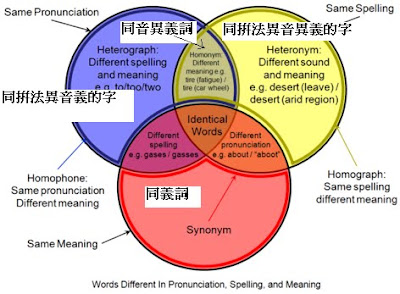
Homonyms are the words that pronounced or spelled the same way but have different meanings.

Sentence, Sentence

The former president of Taiwan was sentenced to life in prison.
He wrote long sentences to the court.

Life, Life

Life is beautiful and created by God.
Mr Chen would spend his life time in prison.

Homonym 同字異義


sentence (句子, 判決)
The former president, Chen Shui Bian was sentenced to life in prison yesterday.
This is a long sentence.

life (終身, 生命)
life is the experience of being alive.
The judges sentenced Mr Chen to life in prison.

charge, charge
I charge my students $XXX per lesson.
The Taiwan ex-president was convicted of a total of six charges.

fine, fine
I am fine, thank you.
The ex-president was fined $6 millions.

demonstrate, demonstrate
I use the power point to demonstrate the findings.
The supporters of Mr Chen demonstrated near the court.

frequent, frequent
He likes to frequent the bar.
Mr Chen frequently clashed with Chinese leaders by asserting Taiwan's independence.

9/11/2009

Homonym Words

Write a story with the following three pairs of homonyms.
left, left (左,離開)
row, row (一列, 划船)
bear, bear (熊,承受)

Shirley and Karen were good friends. They always sat together on the first row of their classroom. They left school and worked for a Teddy Bear House in Tsim Sha Tsiu when they were sixteen. Shirley wrote with her left hand but rowed boat with her right hand. Karen wrote and rowed with her right hand. Both of them have their own boats which could bear heavy loads.

Homonymy of English Words


homonym 同音異義詞
Homonyms are words that are pronounced or spelled the same way but have different meanings since they come from different origins. Homonymy is the state of being homonym.

Examples of homonyms are stalk (which as a noun can mean part of a plant, and, as a verb, to follow/harass a person), bear (animal) and bear (carry), left (opposite of right) and left (past tense of leave). Some sources also consider the following trio of words to be homonyms, but others designate them as "only" homophones: to, too and two (actually, to, to, too, too and two, being "for the purpose of" as in "to make it easier", the opposite of "from", also, excessively, and "two", respectively).

Extracted and adapted from Wikipedia at http://en.wikipedia.org/wiki/Homonym

19 Life Skills

I read an article from the following website that provides information and ideas for enhancing life skills adapted from the website entitled The Life Model .

Skill 1 - Share Joy
Mutual amplification of joy through nonverbal facial expressions and voice tone conveys, “We are glad to be together.” This capacity allows us to bond and grow strong brains as well.

Skill 2 - Soothe Ourself
Lowering the energy level so we can rest after both joyful and upsetting emotions, as we need to and on our own, makes us feel stable. This self-soothing capacity is the strongest predictor of good mental health for the lifetime.

Skill 3 -Form Bonds for Two
The essence of a secure bond is the ability to synchronize our attachment centers so that we can move closer or farther apart at moments that satisfy us both. Synchronized attachment centers provide the basis for smooth transfer of brain skills and learned characteristics.

Skill 4 - Create Appreciation

High levels of the emotional state of appreciation closely match the healthy balanced state of the brain and nervous system. Creating a strong feeling of appreciation in yourself or others relieves unpleasant states and stress. Appreciation is very similar to the let down reflex that produces milk flow when nursing and the warm contented feeling that follows for mother and child.

Skill 5 - Form Family Bonds
Family bonds allow us to feel joy when we have a good relationship with each other. We experience what they feel and understand how they see.

Skill 6 - Identify Heart Values From Suffering
Everyone has issues that particularly hurt or bother him/her and always have been the way he/she is likely to get hurt. Looking at these lifelong issues helps identify the core values for each person’s unique identity. We hurt more as we care more. Because of how much pain our deepest values have caused, most people see these characteristics as liabilities not treasures.

Skill 7 - Tell Synchronized Stories
When our brain is well trained, our capacity is high and we are not triggered by the past, our whole brain works together. Telling stories in a way that requires all the brain to work together is a simple test of how our brain is working as well as a method to train the brain.

Skill 8 - Identify Maturity Levels

We need to know our ideal maturity level so we know if our development is impaired. Knowing our immediate maturity level from moment to moment lets us know if we have been triggered into reactivity by something that just happened or have encountered a “hole” in our development that needs remedial attention. Watching when our maturity level is slipping also tells us when emotional capacity has been drained in us or others.

Skill 9 - Take a Breather
Sustained closeness and trust requires us to stop and rest before people become overwhelmed and when they are tired. These short pauses to quiet and recharge take only seconds. Those who read the nonverbal cues and let others rest are rewarded with trust and love.

Skill 10 - Tell Nonverbal Stories

When we want to strengthen relationships, resolve conflicts, bridge generations or cultures we get much farther with the nonverbal parts of our stories than with words.

Skill 11 - Return to Joy from the Big Six Feelings

Although we live most of our lives in joy and peace we need to learn how to stay in relationship and quiet our distress when things go wrong. When we take good care of our relationships, even when we are upset, the upset does not last long or drive people away. We quickly resolve our “not glad to be together” moments.

Skill 12 - Recall the harmonious moment

Part of maintaining our relationships when we are upset is learning to act like the same person we were when we had joy to be together. A lack of training or bad examples causes us to damage or withdraw from the relationships we value when we get angry, afraid, sad, disgusted, ashamed or hopeless.

Skill 13 - See What God Sees
Hope and direction come from seeing situations, ourselves and others they way they were meant to be instead of only seeing what went wrong. This spiritual vision guides our training and restoration. Even forgiveness flows from seeing people’s purpose as more important than their malfunctions and makes us a restorative community instead of an accusing one. Through our hearts we see the spiritual vision God sees.

Skill 14 - Stop the Sark

This Greek word (also rendered sarx) refers to seeing life according to our view of who people are and how things should be. This conviction, that I know or can determine the right thing to do or be, is the opposite of heartsight in skill 13. For the sark, people become what they have done (the sum of their mistakes) or what we want them to become for us. Blame, accusations, condemnation, gossip, resentment, legalism, self-justification and self-righteousness are signs of the sark.

Skill 15 - Quiet Interactively

Facial cues, particularly of fear, help us to know when we are pushing others too hard. Sometimes we need and want to maintain a high-energy state without “going over the top,” like knowing when to stop tickling so it stays fun. Fast recognition and response to facial cues means optimum interactions and energy.

Skill 16 - Recognize High and Low Energy Response Styles
Many characteristic responses to emotions and relationships are strongly shaped by our tendency toward high or low energy reactions. Recognizing who tends to respond with high energy (adrenalin based emotions) and who would rather withdraw helps us match minds with others and bring more helpful variety to our own response tendencies.

Skill 17 - Identify Attachment Styles

How well we synchronize our attachments (Skill 3) early in life leaves the most enduring pattern in our personality. These patterns change the way we experience reality. At one end we may give almost no importance to our feelings or relationships and at the other we may feel hurt almost constantly and think of nothing but feelings and people. We may also become afraid of the very people we need. All these factors distort our reality but feel real to us at the time. Knowing how to spot these distortions helps us compensate.

Skill 18 - Intervene Where the Brain is Stuck
By recognizing the characteristic pain at each of the brain’s five levels we can pinpoint trouble and find a solution if someone gets stuck. The type of pain gives us a good idea of the kind of solution we will need when someone is not “keeping it together,” “falling apart,” or “stuck” as we commonly call these losses of synchronization.

Skill 19 - Recover From Complex Emotions
Once we can return to joy and act like ourselves with the six big negative feelings taken one at a time, we can begin to learn how to return to joy and act like ourselves when the six are combined in various combinations. Shame and anger combine to form humiliation. Fear and hopelessness (with almost any other feeling as well) form dread. These combination feelings can be very draining and difficult to quiet.

http://www.lifemodel.org/videowmp.php?file=thriveOverview_02.wmv

8/22/2009

Tutankhamun


16 August, 2009

King Tut Exhibition

More than 3,000 years after his reign, and 30 years after the original exhibition opened in San Francisco, Tutankhamun, ancient Egypt’s celebrated “boy king,” returns to the de Young Museum. In the summer of 2009 the de Young presents Tutankhamun and the Golden Age of the Pharaohs, a glorious exhibition of over 130 outstanding works from the tomb of Tutankhamun, as well as those of his royal predecessors, his family, and court officials.

On view from June 27, 2009, through March 28, 2010 at the de Young, Tutankhamun and the Golden Age of the Pharaohs provides insight into the life of Tutankhamun and other royals of the 18th Dynasty (1555–1305 BC). All of the treasures in the exhibition are more than 3,000 years old.

Tutankhamun was one of the last kings of Egypt’s 18th Dynasty and ruled during a crucial, turmoil-filled period of Egyptian history. The boy king died under mysterious circumstances at the age of 18 or 19, in the ninth year of his reign (1322 BC). Tutankhamun’s tomb in the Valley of the Kings was filled with magnificent treasures meant to ensure his divine immortality. Many objects belonging to the young king—exquisite personal items used in his daily life—were placed in it.

Tutankhamun and the Golden Age of the Pharaohs offers glimpses of that critical period in Egyptian history. On display will be 50 of Tutankhamun’s burial objects, including one of the gold and precious stone inlaid canopic coffinettes that contained his mummified internal organs. Also included are many of the day-to-day objects enjoyed by the young king including a finely crafted child’s chair and an inlaid game board, one of four in the tomb, clearly representing an activity enjoyed by the king.

New to the encore tour of the exhibition are two nested coffinettes that contained the remains of two fetuses that are now undergoing DNA testing to reveal their relationship to King Tut. Also new to the exhibition from Tutankhamun’s tomb is a beautiful scarab bracelet featuring a central image of a beetle representing the sun god. An elaborate pectoral, a masterpiece of jewelry making, contains a rare, yellow-green glass stone carved in the shape of a scarab beetle that some scientists believe to be a fragment of an ancient meteorite.

More than 80 additional objects from tombs of 18th Dynasty royals, as well the possessions of elite individuals with close connections to the royal family also will be exhibited. These stone, faience and wooden pieces from burial sites before Tut’s reign will give visitors a sense of what the burials of both royalty and the elite may have been like and what the Egyptians of that time considered essential for the afterlife.

King Tut’s Gold Mask (or "Funerary Mask" or "Death Mask") resides at the Egyptian Museum in Cairo. The Mask is a very popular object that traveled in the 1970s exhibition and many individuals have fond memories of it. However, in the 1980s the Egyptian government declared it a national treasure and too fragile to travel. As such, it will not leave Egypt again and does not appear in Tutankhamun and the Golden Age of the Pharaohs.

Tutankhamun’s mummy, the outermost of the three coffins in which he was buried, and his quartzite sarcophagus are still located in his tomb in the Valley of the Kings in Egypt. The two additional coffins—the innermost solid-gold coffin and second coffin—are in the collection of the Egyptian Museum in Cairo. King Tut’s mummy, coffins, and sarcophagus have never traveled outside of Egypt.

Exploratorium


5 August, 2009

We visited Exploratorium on 5 August, 2009. It is a well known museum in San Francisco. It is a hands-on museum of science, art, and human perception. It has been called both the best science museum in the world and the grandfather of experimental and hands-on museums.

It is designed to spark curiosity. Visitors can touch, pick up, and tinker with hundreds of exhibits. Their curiosity will guide them to discover knowledge of the physical and biological world through the processes of discovering and validating.

There are a number of online activities on the link, http://www.exploratorium.edu/explore/online.html. Try if you are interested to know more about them.

One of the event, I enjoyed during my visit is the activities that you can access at:
http://www.exploratorium.edu/reflections/

8/20/2009

Bonfante Gardens - Gilroy Family Theme Park


3rd August, 2009 (Monday)

We visited the Gilroy Family Theme Park on 3rd August, 2009. There were a number of interesting rides for us.

Jelly Belly Factory Tour


1st August, 2009 (Saturday)

Jelly Belly Factory Tour

We visited Jelly Belly Factory on 1st August, 2009. It was located in Fairfield, California about an hour's drive north of San Francisco.

We arrived there at about 4 o'clock. Luckily we could join the last tour that lasted for about 40 minutes. During the tour, the tour guide explained to us how the jelly beans were made. It took about four to five days to make the jelly beans. All visitors got a bag of jelly bean as a free gift from the company.

I bought five bags of jelly beans. They looked and tasted really great.

8/01/2009

Terri's Vacation

Terri is on vacation to the States from 25 July to 17 August, 2009.
The photo was taken on the plane on 25 July. It's so nice to have a break spending time with my dearest family members.

7/16/2009

Fluency Training

What is fluency and how can you achieve fluency in your speech?

Fluency is the ability to communicate your thoughts and feelings and to say what you want to say without fear and hesitation. The foundation of fluency is the urge to express yourself adequately in various circumstances; such as social, academic, or work place settings.

Now, you can start working to find ways to enhance your speech ability by using the technique of reading aloud. There are steps you need to follow:
1. phrasing - words go together in groups - identifying thought/ intonation groups
2.pausing – with rhythm and phrasing – pauses should be left between thought groups
3.linking - joining sounds into words and words into phrases and sentences

Understanding the rhythm of English speech is important for learners. You will realise that any long segments of connected speech are made up of certain patterns, known as tone units. To speak effectively and comprehensively, we need to divide our speech into tone units for each thought group.
The tone unit is a part of the sentence in which there is a significant pitch pattern. Within it there will be some prominent/ stressed syllables. Stress is one the main tools in English to convey word and sentence meaning. It is important for you to control the stress system if you want to be able to speak English clearly.

7/06/2009

Introduction to the IELTS Test

Introduction to the IELTS Test

The International English Language Testing System (IELTS) is a test of English language proficiency, developed by the University of Cambridge Local Examinations Syndicate. IELTS is now accepted as evidence of a prospective student’s level of English by most universities in English speaking countries.

There are two different IELTS tests that you can do: Academic and General. IELTS is not a test that you can pass or fail. Your assessment will be reported according to a scale from bands one to nine. You will need to contact the university you wish to enter to find out the IELTS score they require for entry into your chosen course. Band one indicates that you have virtually no English at all. Band nine is native speaker proficiency. Universities in Australia typically require a band score of between 6 and 7. The test questions and tasks have been designed to reflect the general interests of people from an educated background. You will therefore not be required to have any specialist knowledge.

The test has four components – Reading, Writing, Listening, Speaking. You will receive a band score for each component as well as a global band score.

The modules are always taken in the same order: listening, reading, writing, and speaking.

1. Listening: [Time: 30 minutes; 4 sections; 40 items]
Candidates listen to a number of recorded texts, which increase in difficulty as the test progresses. These include a mixture of conversations and dialogues and feature a variety of English accents and dialects. The recording is heard only once, but candidates are given time to read the questions and record their answers.

2. Reading: [Time: 60 minutes; 3 sections; 40 items]
Academic Reading: There are three reading passages with tasks. Texts are taken from books, magazines, journals and newspapers, all written for a non-specialist audience. At least one of the texts contain a detailed argument.
(or) General Training Reading: The texts are based on the type of material candidate would be expected to encounter on a daily basis in an English speaking country. They are taken from sources such as newspapers, advertisements, instruction manuals and books, and test the candidate's ability to understand and use information. The test include one longer text, which is descriptive rather than argumentative.

3. Writing: [Time: 60 minutes; 2 tasks - 150 & 250 words]
Academic Writing: For the first task, candidates write a report of around 150 words based on material found in a table or diagram, demonstrating their ability to describe and explain data. For the second task candidates write a short essay of around 250 words in response to an opinion or a problem. They are expected to demonstrate an ability to discuss issues, construct an argument and use the appropriate tone and register.

(or) General Training Writing: The format of the test is the same as the equivalent Academic module. The fist task requires candidates to write a letter either asking for information or explaining a situation. The second task is a short essay of around 250 words, and is written in response to a given point of view or problem. Candidates are expected to be able to present their own ideas and challenge other ideas, using the appropriate tone and register.

4. Speaking: [Time: 10 - 15 minutes] The test takes the form of a face to face interview between one candidate and one examiner. Candidates are assessed on their use of spoken English to answer short questions, speak at length on a familiar topic, and also to ask questions and interact with the examiner.

Total testing time: 165 minutes ( 2 Hours and 45 minutes). All modules are usually taken on the same day, but in some cases the Speaking test may be taken up to two days after the other modules.

social conversation1 3 1