Planning how to spend your time wisely can help live a successful live. You may start your day by planning things you would like to focus on early in the morning. Write a to-do list. It can help you better use your time.
Try to fill in the list to help you organise your day. See the sample list below.
Date: ______________
1. Read-aloud your selected articles twice a day
2. Write down and spell the words you don't really know
3. Finish two pieces of summer homework everyday.
Check the list at the end of the day. See how many items you have finished working on them.
7/25/2008


7/21/2008
Chunking Sentence into Phrases

Sentence chunking is the way in which we divide long sentences into shorter pieces, separated by slight "mental" pauses, in order to help reader, speakers, and listeners organise meaning for communication purposes.
As readers, it is important to have your eyes' fixations lie on the chunking bits; i.e. thought groups marked with slight 'mental' pauses, usually each thought group contains a keyword. Chunking is crucial for comprehending long passages.
Similarly, when we speak English, we do not speak in single words but in groups of words uttered meaningfully and rhythmically.
As listeners, we will also focus our attention on the meaning units rather than individual sounds. It helps better understand speaker if we can follow chunks of the big sound waves we hear.
7/14/2008
Story Writing
 What is story?
Story is a piece of writing that describes a chain of related events. Every story is about one or more characters trying to deal with some sort of difficulty.
What is a story map?
A story map is a map that helps writer organise the story by focusing on characters, setting, and plot with some related series of events that starts with beginning, rising, climax and ending.
What is a story plot? What are the eight types of plot we can find in story?
A plot can be defined as the arrangement of narrative events in a story. It is usually organised in such a way as to create interest and involvement for the reader. It also helps to establish and emphasise causality. There are usually eight types of plot mapped by writer to devise the sequence of events in the story. The eight types of plot can be devised and mapped from:
1. problem to solution,
2. mystery to solution,
3. conflict to peace,
4. danger to safety,
5. confusion to order,
6. dilemma to decision,
7. ignorance to knowledge, and
8. questions to answers.
Task: Read the story, “The Fight”. Discuss the ways that the plot is developed by the writer. Fill in the story map at the end of the story.
Try to answer the following questions when you read the story.
- Who is the main character in the story?
- What is the setting of the story?
- What happen in the story? How did the writer arrange the development of its plot ?
 "My nose is bleeding! He hit me!”
The nine-year-old boy, Jimmy was screaming, holding his bloodied nose, leaving a trail of blood to the bathroom. His seven-year-old brother, Michael, had punched on it, after an argument over control of the TV remote.
Their mother, Mrs. Lam saw them fighting. Her first thought, on this day of long summer school break was, “It’s eight-thirty in the morning and these two are at fight again. I can’t go through another day like this.”
Mrs. Lam sent Michael to his room for a time-out and got Jimmy cleaned up. Then she called both of them into her bedroom for a talk. She wasn’t angry with them, only disappointed in her leadership of their home; not able to help her sons live in harmony and work out their differences.
Mrs. Lam sat between them with an arm around each. “Let’s talk about this. You are fighting and hitting a lot and it upsets all of us. Jimmy, would you tell Michael how you are feeling right now?”
Jimmy stared at Michael and shouted, “My nose hurts! You hit me for no reason! You kept pinching me and I told you to stop! The only way to get your attention was to take the remote and then you hit on my face.”
Michael was angry, too, and he started his rebuttal: “You always hit me!”
Mrs. Lam interrupted Michael and asked him to repeat what he just heard Jimmy say.
Michael said, “I’ve always got the remote and nobody likes me.”
Mrs. Lam prompted Michael, “What else did you hear Jimmy say?”
"His nose hurts and I was pinching him and he got in the way of my head," Michael said. - "Jimmy, is that what you said,”
"Yes. He didn’t have to smash my nose!”
Mrs. Lam said, “How do you see what happened, Michael?”
"Jimmy always gets to do anything he wants! When I’m watching TV he always turns the channel! When I’m playing with something, he takes it away and says it’s his!”
Their mother said, “Jimmy, what did you hear Michael say?”
“Michael thinks that I take over every thing and get to do anything I want.”
“Is that right, Michael?”
“Yeah.”
They went through a few more rounds of “What did you hear him say and did he get it right?”
The mood in their home changed for the positive in a few minutes. The boys started to look at each other, smile, and make jokes. The tension was gone and feelings were understood.
Then Mrs. Lam asked, “The next time you guys disagree with the TV channel or anything else, what can you do besides hit?”
Jimmy thoughtfully answered, “Go and do something else or talk to Mom or Dad.”
Michael added, “Go outside or play with others.”
"How about if you look at the TV listings for one or two programs each day and talk with each other ahead of time about what you want to watch?”
"That’s a good idea!" They were through talking now.
Mrs. Lam was amazed at how understanding each other’s feelings and viewpoints help solved the conflict and raised self-esteem. The boys saw themselves differently, more capable and in control because of the ideas they came up with.
7/09/2008
Ways to Improve Your English - Add Life to Your Learning

The essence of effective language learning is to add "life" element to your learning. What does it mean? It means the process learning language involves not only the language items but also the interactive processes of: social, cultural, intellectual, and life enhancement. They are all spirit-related.
(John 6:63 ) The Spirit gives life; the flesh counts for nothing. The words I have spoken to you are spirit and they are life.
The essence of effective language learning is to learn to understand so to add the “life” to one’s learning.
Proverbs 16:22 Understanding is a fountain of life to those who have it, but folly brings punishment to fools.
What does adding “life” to learning means ?
It means the process learning language involves not only the language items but also the interactive processes of: social, cultural, intellectual, and life enhancement. They are all spirit-related.
John 6:63 The Spirit gives life; the flesh counts for nothing. The words I have spoken to you are spirit and they are life.
Impact
Good teaching and learning should have a meaningful impact on individual life.
Acts 5:20 Go ye, and stand ye, and speak in the temple to the people all the words of this life.
7 ways to enhance language learning:
- Learn by listening: Make use of the English television or radio news to learn English so to better understand the world around you.
- Learn by reading: Read news in English newspaper at least twice a week. Learn the titles of the news. They are windows for showing you the "life" around. Learn them so you have more to talk about.
- Learn by incorporating learning resources into daily life: Read and study English daily by checking and reading English e-mail messages or learning resources on the Internet.
- Learn by using vocabulary in phrases: Keep a note of phrases you find useful to develop your language or personal skills
- Learn by repeating: Repeat and study the phrases that is meaningful to you.
- Learn by memorizing: Know the styles of learning that will work for you. For example, you may need to write an expression several times before you can remember it; you may need to read aloud to memorize ideas or information you consider to be important; or you may need to talk more in order to gain confidence in expressing yourself.
- Learn by writing and sharing ideas: Use a variety of exercises to develop your English skills. You may develop or record the exercises that you think useful and share them with your friends. Keep a record of your learning by writing blog messages
7/08/2008
Kid IQ Quizzes
1. Sam gets a gift from his father. He then throws it onto the floor. Do you know why?
2. Sam wants to move the picture of the upside-down man to the normal position without moving the picture. Do you know how he can do it?
3. Sam’s father shoots and kills one of the six hummingbirds flying near a tree. How many birds will stay there on the tree?
4. Sam asks his friend Tom, “What animal will eat happily at night?”
2. Sam wants to move the picture of the upside-down man to the normal position without moving the picture. Do you know how he can do it?
3. Sam’s father shoots and kills one of the six hummingbirds flying near a tree. How many birds will stay there on the tree?
4. Sam asks his friend Tom, “What animal will eat happily at night?”
7/03/2008
Session Ten - Vocabulary words pronunciation
Do you know the following vocabulary words? If not, check their pronunciation and meaning from a dictionary. You may want to pronounce the words before you check the sounds from a dictionary.
1. conventions
2. truant
3. soliloquize
4. interregnum
5. atavism
6. cogitation
7. prudery
8. translucent
9. efficacy
10.injudicious
11.lugubrious
12.hullabaloo
13.penurious
14.figurative
15.ribaldry
16.convolution
17.superfluous
18.ministration
19.circuitous
20.alacrity
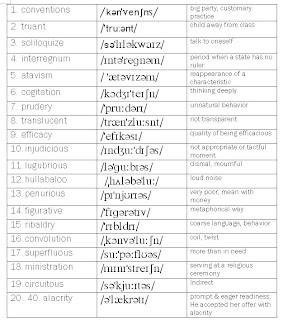
1. conventions
2. truant
3. soliloquize
4. interregnum
5. atavism
6. cogitation
7. prudery
8. translucent
9. efficacy
10.injudicious
11.lugubrious
12.hullabaloo
13.penurious
14.figurative
15.ribaldry
16.convolution
17.superfluous
18.ministration
19.circuitous
20.alacrity

Session Nine - Thought Groups
Tips for identifying thought group divisions
- Falling pitches mark the end of thought group.
- Pauses also indicate the end, it gives listeners time to think about what's been said.
- The use of punctuation can help identify the thought groups; in spoken format speakers use a falling pitch or a pause to indicate the marks.
- The mastery of employing thought groups can improve clarity of both speech and listening.
- The alteration between syllables that are stressed and pronounced clearly and syllable that are unstressed and spoken quickly forms the prosody of English language.
- Sentence emphasis and de-emphasis act as the discourse navigational guides to distinguish the new and old (shared) information in speaking.
- Words carried old information are said with relatively weaker stress and lower pitch.
- Words that are focus of thought (with new information) are highlighted by a lengthening of the stressed syllable and a change in the pitch.


Session Seven - Consonants
Task 1: Work on a warm-up exercise by distributing the twenty four IPA consonant cards to participants. Cover the cards and randomly say the sounds of the IPA symbols. Participants will reveal their cards as the corresponding sounds are read-aloud. Those who can show the right card will win and can enter to the second round of the game. Shuffle the cards again and read-aloud the sounds faster this time. Participants who can show their cards correctly will win and enter the third round of the game. Reshuffle the cards again and say it faster than the second time. The game will stop if the facilitator considers participants have sufficient practice to expose to the sounds.
Task 2: Can you think of any words which contain the following consonant sounds? Write one for each symbol.

Task 3: Say and pronounce the words below, focusing on the pronunciation of the consonant sounds. Remember to focus in particular on the pronunciation of final consonant sounds.
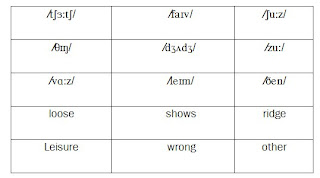
Task 2: Can you think of any words which contain the following consonant sounds? Write one for each symbol.

Task 3: Say and pronounce the words below, focusing on the pronunciation of the consonant sounds. Remember to focus in particular on the pronunciation of final consonant sounds.

Session Six - Word Stress

000O0
Seven stress Rules
- When a word contains a prefix and /or suffix, the accent usually falls on or within the root word.
- The stress usually falls on or within the first word of a compound word.
- In a two-syllable word that functions as either a noun or a verb, the stress is usually on the first syllable when the word functions as a verb.
- When there is a double consonant within a word, the stress usually falls on the syllable that ends with the first letter of the double consonants.
- In multisyllabic words ending in tion, the primary stress falls on the syllable preceding the tion ending.
- When the vowel phoneme within the last syllable of a two-syllable word is composed of two vowel letters, that syllable is usually stressed.
- When there is no other clue in a two-syllable word, the stress most often falls on the first syllable.
Session Five - Six Consonants
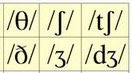 voiceless th - thin, third, mouth, north, three,threat, health, and length
 voiced th - that, there, breathe, bathe, breathes, bathes
voiceless sh - shop, shut, fish, ash, shrimp, shrine, trashed, crashed
voiced sh - rouge, garage, rouged, garaged
voiceless ch - China, church, much, rich, lunch, fetch
voiced ch - join, gin, huge, ridge, lounge, George
6/30/2008
Session Four - Name Transcription
The relationship between English sounds and spellings can be well illustrated by studying Chinese names.
The following are some of the examples:
陳李張王何趙錢周吳鄭王馬謝曹梁
Chan Lee Cheung Wong Ho Chiu Chin Chow Ng Cheung Wong Ma Tse Tso Leung
Can you transcribe the above surnames into IPA symbols?
The following are some of the examples:
陳李張王何趙錢周吳鄭王馬謝曹梁
Chan Lee Cheung Wong Ho Chiu Chin Chow Ng Cheung Wong Ma Tse Tso Leung
Can you transcribe the above surnames into IPA symbols?
Session Three - Vowels and Diphthongs
Circle the word which does not rhyme/ has the same vowel or diphthong sound with the word on the left?
- alone phone shown thrown town
- buys advise price stick tries
- clear bear beer dear fear
- goes chose lose shows toes
- knees niece peas pace trees
- made afraid paid played said
- most cost post roast toast
- roof boot foot shoot suit
- shoes choose does lose food
- there care hair here wear
- thumb come home some sum
- throw go know toe too
- weight great height late straight
- word bird heard lord third
- worse horse nurse purse reverse
Session Two - Sound Blending
Task 1:
Fill in the table with the right words:bad, bit, cut, box, bed, lot, let, lit, gun, dad, rat, red, rid, rod, rusty.


Fill in the table with the right words:bad, bit, cut, box, bed, lot, let, lit, gun, dad, rat, red, rid, rod, rusty.

gate, bone, mute, free, file, tail, boat, due, pie, pea, bay, deep, high, foe,
dew
dew

germ, deep, turn, term, cork, zoo, cheese, yard, farm, meat, pawn, put, scar, born, shoot

rare, beer, poor, tour, steer, share, join, loud, gown, toy

6/25/2008
Session One - An Introductory to the 44 IPA Sounds
The first lesson is a challenging lesson. How can I help the participants become confidence in learning English pronunciation? Most participants have never learnt International Phonetic Alphabet before. So I decide to focus on familiarising them with the 44 IPA symbols. I also introduce the relationship between 26 English alphabet letters and 44 IPA sounds.
44 IPA letters
24 consonants
20 vowels

44 IPA letters
24 consonants

8 paired consonants
p, f, t, k, s, th, sh, th (voiceless)
b, v,d,g, z, th, sh, th (voiced)
8 single consonants
m, n, ng, l, r, w, y (voiced) h (voiceless)
20 vowels

Long Vowels: ae, ee, ie, oe, ue
Short Vowels: a, e, i, o, u
R-Vowels: ar, er, ir, or, oo
Diphthongs: are, eer, oor, oi, ou
Short Vowels: a, e, i, o, u
R-Vowels: ar, er, ir, or, oo
Diphthongs: are, eer, oor, oi, ou
6/24/2008
English IPA Pronunciation Course

I am teaching a pronunciation course these days. The aim of the course is to help participants learn the International Phonetic Alphabet (IPA) sounds and their corresponding English letters. It is expected that by the end of the course participants will be able to
- recognise the IPA symbols and their frequently associated spelling patterns so that learners can check up words in a dictionary and pronounce them accurately

- understand the relationship between sounds and spelling patterns of words
- differentiate the 44 phoneme sounds of English
- identify the syllables in words and phrases
- read words and phrases with appropriate stress, andcontinue with the learning of pronunciation independently.
 The total duration of the course is twenty hours. It takes ten sessions to complete the course. I will share more with you - how I prepare for all the ten sessions of the course in the coming ten days. I will also share how the participants react to some of the learning tasks and the in-class activities I've prepared for them.
6/16/2008
A Testimonial for My Daugther School - the ICQM
I am grateful that my daughter, Carol has been studying at the International Christian Quality Music Secondary and Primary School for the past five years. I can see the difference that the school education has made on her.
Carol is tall and strong physically. But when it came to her intellectual and character development, I was really worried for her. It has been a great challenge to my family because Carol used to be a very strong-will child. There was always tension between us – mother and daughter. I could hardly make her work on anything that she did not like or did not feel comfortable with.
The tension has been easing since Carol joined the ICQM. She becomes more aware of her weaknesses and strengths. She is more willing to accept God’s love and guidance. These help her change and face her challenge more bravely. I can now see her become happier and cleverer in problem solving. I reckon it is because she has been surrounded by supportive teachers and good classmates.
Her teachers are patient, caring, and professional. I am especially impressed by her class teacher, Miss Kwok who shows her love, wisdom, and determination to help students blossom in their ways and time. She has always been supportive to their emotional needs, and constantly finds ways to help them grow intellectually and spiritually. Most importantly, she can easily discover the uniqueness of her individual students, e.g. Carol's strength and weakness, and respond to them accordingly.
I also appreciate the mental space created by the school teachers - not demanding too much from Carol when she was not ready. This helps Carol shift her negative feeling on studies to a positive mode of leisure reading and learning. This, in turn has built her confidence in learning and developed her habit in reading and self learning. In fact, the habit of reading and self-learning helps her blossom when it comes to her time - to finish the final year of her primary school study.
Apart from positive impact from the good teachers, I think Carol’s classmates have also helped her enjoy her school life and her studies. Being a mother, I really want to see Carol live a happy, healthy, and meaningful life. I also think it is important for her to have a strong faith in God and receive God’s love and respond to God's grace accordingly. I am now confident to say that her school is laying a good groundwork developing both her intelligence and character.
Thank you God, and thank you ICQM!
Carol is tall and strong physically. But when it came to her intellectual and character development, I was really worried for her. It has been a great challenge to my family because Carol used to be a very strong-will child. There was always tension between us – mother and daughter. I could hardly make her work on anything that she did not like or did not feel comfortable with.
The tension has been easing since Carol joined the ICQM. She becomes more aware of her weaknesses and strengths. She is more willing to accept God’s love and guidance. These help her change and face her challenge more bravely. I can now see her become happier and cleverer in problem solving. I reckon it is because she has been surrounded by supportive teachers and good classmates.
Her teachers are patient, caring, and professional. I am especially impressed by her class teacher, Miss Kwok who shows her love, wisdom, and determination to help students blossom in their ways and time. She has always been supportive to their emotional needs, and constantly finds ways to help them grow intellectually and spiritually. Most importantly, she can easily discover the uniqueness of her individual students, e.g. Carol's strength and weakness, and respond to them accordingly.
I also appreciate the mental space created by the school teachers - not demanding too much from Carol when she was not ready. This helps Carol shift her negative feeling on studies to a positive mode of leisure reading and learning. This, in turn has built her confidence in learning and developed her habit in reading and self learning. In fact, the habit of reading and self-learning helps her blossom when it comes to her time - to finish the final year of her primary school study.
Apart from positive impact from the good teachers, I think Carol’s classmates have also helped her enjoy her school life and her studies. Being a mother, I really want to see Carol live a happy, healthy, and meaningful life. I also think it is important for her to have a strong faith in God and receive God’s love and respond to God's grace accordingly. I am now confident to say that her school is laying a good groundwork developing both her intelligence and character.
Thank you God, and thank you ICQM!
A Touching Story - A Unique Teacher
You may want to watch a touching story about a school teacher, Mrs Thompson and her student, Teddy Stoddard. The power point link can be found at http://www.teachermovie.com/ . You may also read the text version at Snopes.com where the origin of this fiction story is provided.
I beleive all of us can be the unique ‘ teacher' to others in life.
I beleive all of us can be the unique ‘ teacher' to others in life.
5/30/2008
Blogging Your Learning Experience
To make yourself learn better, you need to develop a study plan and share how you make the plan work. The plan is crucial to motivate and help you to learn and enhance your English skills in a long run. You also need it for record-tracking your learning journey. The record can help you see how you reach your learning goal so you are more aware of the responsibility for your own learning.
Blogging can help stir up your desire to learn. The desire can fade out without a support from others. Using the blog can easily gain the support. Start by sharing your experience in learning some new phrases everyday. Talk about something that impacts your daily life. Use the blog to record your thinking, this helps you express better in writing. Share the blog with your friends as much as possible.
Most importantly, no man is an island. We can't really isolated ourselves. We enjoy learning and sharing. We want to grow both intellectually and spiritually. We can't grow without learning. Learning takes a life time. Learning a new language also means appreciating some new culture and value that you may not have encountered before. Take myself as an example, I am Christian. I read Holy Bible every day. I did it ritually and didn't gain much insight until I started switching the language mode from Chinese to English. I now gain a lot more insight from the Words in the Bible. It impacts me immensely, because I can make a better reflection when memorising and mediating the Words in the second language.
Blogging can help stir up your desire to learn. The desire can fade out without a support from others. Using the blog can easily gain the support. Start by sharing your experience in learning some new phrases everyday. Talk about something that impacts your daily life. Use the blog to record your thinking, this helps you express better in writing. Share the blog with your friends as much as possible.
Most importantly, no man is an island. We can't really isolated ourselves. We enjoy learning and sharing. We want to grow both intellectually and spiritually. We can't grow without learning. Learning takes a life time. Learning a new language also means appreciating some new culture and value that you may not have encountered before. Take myself as an example, I am Christian. I read Holy Bible every day. I did it ritually and didn't gain much insight until I started switching the language mode from Chinese to English. I now gain a lot more insight from the Words in the Bible. It impacts me immensely, because I can make a better reflection when memorising and mediating the Words in the second language.
5/27/2008
Playing Dual Roles: Teacher and Student
You will have a lot of fun if you can play dual roles being a teacher and a learner to enhance your English skills. The ideas below provide some tips.
- Use audio materials to teach yourself. If possible, help yourself listen to learn before you will read to learn.
- Make yourself answer and respond to the listening and reading tasks. So, you will engage in deep learning not the superficial learning.
- Get into the details. Learning happens when it touches on the great details of the subject. So, read and listen to something that you are immensely interested in. Your study will also satisfy your intellectual thirst.
- Take time to show yourself the learning materials as many times as you can. It is necessary to repeat the listening and reading. Give yourself a break if you are bored by the reading.
- Record your own reading or speaking. You will see your own progress in the process.
- Tell yourself that you appreciate and value your effort. Believe in yourself and your ability of learning English.
Subscribe to:
Posts (Atom)


-
 Beethoven Symphony No. 5 (貝多芬第五交響曲) The coversheet to Beethoven's 5th Symphony The dedication to Prince J. F. M. Lobkowitz and Count Ra...
 -
Planning how to spend your time wisely can help live a successful live. You may start your day by planning things you would like to focus on...
-
Try to answer the following three questions that will give you ideas regarding your style of reading. Are you reading as a passive consumer ...